Full conversation
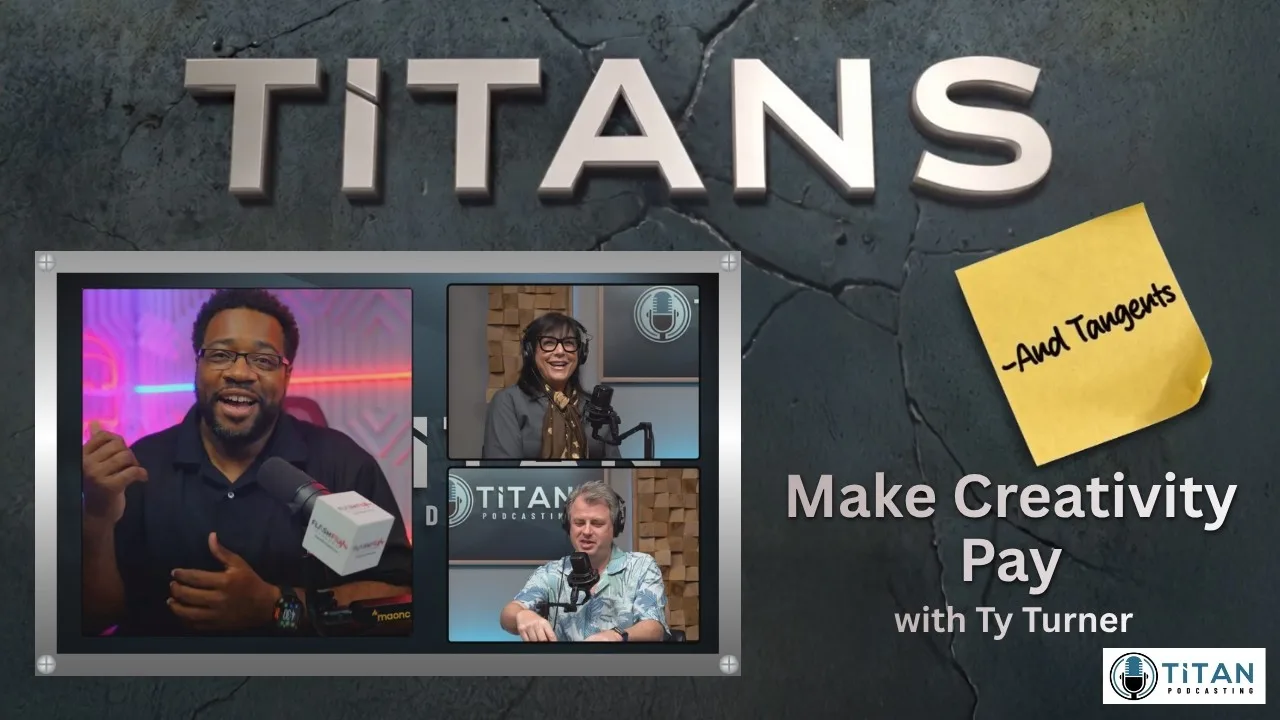
Make Creativity Pay
with Ty Turner
Ty Turner talks about turning creative skill into a sustainable business through clear positioning, a defined audience, practical experience, and the confidence to begin before everything feels perfect.
The full episode
Watch the full conversation
Playing the video connects to YouTube. Watch directly on YouTube
In this conversation
A guide to the subjects discussed.
- 01Creative business
- 02Audience and positioning
- 03Video education
- 04Algorithms and AI
Read the conversation
Full episode transcript
This transcript has completed Titan Podcasting staff review. Timestamps link to the source episode.
Read Full Transcript
- 0:00 on YouTube
Marki Costello
Some people chase trends, others hold the cameras that capture them. This is Titans and Tangents, and today's guest turned creativity into a full-scale business blueprint. Flash Film Academy founder,
- 0:16 on YouTube
Marki and Scott [unison]
Ty Turner.
- 0:16 on YouTube
Marki
[He] started with a passion for capturing meaningful images, sharpened those instincts as a creative director in corporate America, and then stepped out to build something bigger, Flash Film Academy and Flash Film Media. Try saying that three times fast.
A Texas-based production company trusted by powerhouse brands like Toyota, Google, Verizon, and Samsung. But this conversation is bigger than cameras and content.
It's about cutting through the smoke machine of internet gurus, surviving the expensive learning curve, and building a creative career that actually pays the bills.
We're diving into entrepreneurship, storytelling, branding, social media strategy, and what it really takes to turn content creation from a side hustle into a sustainable business. So whether you're filming on a cinema rig or balancing on an iPhone or a coffee mug, you're in the right place.
Because around here, the titans build the future, and the tangents reveal how they got there. Welcome to Titans and Tangents.
- 1:14 on YouTube
Titans & Tangents theme: Titans and Tangents, step inside. Where leaders speak and heroes shine. Stories with purpose. Moments that climb. Titans and Tangents. Now it's time.
- 1:32 on YouTube
Scott Kemp
Yeah, Ty in the house.
- 1:33 on YouTube
Marki
Ba-dum-bum-bum-bum-bum.
- 1:35 on YouTube
Scott
You did a good job reading that. It's like you've done that before.
- 1:37 on YouTube
Marki
It's like I've done it a million and one times. Either you got it or you don't. Ty, welcome to the pod.
- 1:45 on YouTube
Ty Turner
Thanks for having me. Thanks for having me. I appreciate it.
- 1:47 on YouTube
Marki
So Ty, tell me about Flash Films. Talk to me about that.
- 1:53 on YouTube
Ty
So Flash Film Media started really when I had the idea sitting in a meeting while working for TGI Fridays, handling all of their internal content. And I was like, "I think I can get a check from multiple companies doing this."
And so Flash Film Media was kind of really born out of that idea of just seeing what I'm able to do as a single person for a bigger company like TGI Fridays and seeing how I was able to help them grow and develop their learning systems.
I realized just how important the corporate side of content creation was, and I just decided I want to go after more clients like that.
- 2:36 on YouTube
Marki
I love that because I sort of was a disruptor years ago. I had a casting company, and we did reality TV, and you would have to be in-house at a production company and work on one show. And then I opened up my own casting entertainment group, and I was like, "Why can't I do six shows?"
They all eventually feed into each other, and everybody's like, "No! They will never allow you to do it," but I did it. My company cast the very first season of "The Bachelor," that little juggernaut. And now that's how all the companies are running.
They do multiple shows, and I always say I kicked that glass ceiling open and shattered it for everybody else. And my daughter does social media for a bunch of different brands as well. And, I think, knowledge is powerful, and it's power, and why not use it over multiple platforms?
Now, with that being said, let's talk about [it]. I get on Corvallis, Oregon all the time about [how] they don't understand media, they're so afraid of media, they're so afraid of content. And content is king. Let's talk about how important social content is and content, Ty.
- 3:45 on YouTube
Ty
Well, if you've watched me, I use a really harsh term that content is the new crack.
- 3:52 on YouTube
Marki
Yes, I love it.
- 3:52 on YouTube
Ty
And every screen in your house is a crack pipe. Every screen that you keep on you, every phone that you keep around is a way to consume content. So the idea that content is going anywhere is false. Even as we move into the age of AI, we're still going to need a lot of content to fill a lot of screens.
So it's a great time to be a content creator.
- 4:18 on YouTube
Marki
100%. And I'll tell businesses here, I'm like, "This next younger generation," like my 16-year-old, who's about to be 17, this is where he's getting all of his... I told him the other day, I'm like, "Well, see if they have a website." He was like, "A website? If they don't have Instagram or TikTok, they're not legit."
Meaning that next generation, that's the only way they consume it and understand it.
- 4:45 on YouTube
Ty
Not only that. The ability to create content in general has now become a valuable skill set. I was laughed at because I wanted to edit video on my computer. And I wanted to film with my VHS camcorder. Showing my age, but my RCA VHS camcorder.
- 5:02 on YouTube
Scott
Did you edit with the camcorder or the VCR to VCR, hitting record on one play on the other, and then cut them?
- 5:09 on YouTube
Ty
I had a Pinnacle system that would be in between, and it was a weird way. It would fade the... It was bad, but it was the old school Pinnacle system with two VCRs.
- 5:20 on YouTube
Scott
Oh, we did that.
- 5:20 on YouTube
Ty
Or I had a VCR and my camcorder connected to them. And that's how I would edit. And my friends were like, "Man, you're crazy." But I wanted to make movies, and I laugh at that now because my 11-year-old is editing footage on DaVinci Resolve. I started him on CapCut.
- 5:36 on YouTube
Scott
No way
- 5:37 on YouTube
Ty
And now he's deep into DaVinci Resolve editing content.
- 5:41 on YouTube
Scott
Oh, I love it. You got him on your content yet?
- 5:43 on YouTube
Ty
Yeah. Well, a little bit. He has a YouTube channel that he's trying to grow, but yeah.
- 5:49 on YouTube
Scott
So your backstory goes into the military, right? I want to hear a little bit about that.
- 5:55 on YouTube
Ty
Absolutely. So I was a combat photographer in the Army. I'm going to tell you, I'll give you some insight. So I originally didn't go in as a combat photographer. I wanted the position, but it wasn't available. I went in as a medic.
Because I figured, healthcare, when I get out, it's a job that I'll have a skill set that I can live off of if need be. I didn't want to be one of the vets that get out and all we did was kick in doors, and that's not a translatable skill set.
So I went in as a medic, and I was number three in the class grade-wise, and my friend, a good friend that I was friends with from basic training, because his last name was earlier in the alphabet, he was in the class ahead of me. So he would kind of tell me what's coming.
But he ended up failing, and they would tell us in the military, like, "If you fail, you're going infantry." Like, there's nothing to talk about. Either you're a medic, or if you fail, you're going infantry. So nobody really, I'm not going to say nobody really wanted to go infantry, but it wasn't your first choice.
But I learned that when he failed, he got a chance to choose different jobs from different jobs. And one of the jobs on the list was the job I wanted, which was a 25 Victor, combat documentation, photography, and videography.
So when I learned that the job was on the list, I failed on purpose so that I can get kicked out and choose that job. And another crazy thing is we looked in the system, and there were supposed to be 122 slots.
Well, when I failed and got one of those slots and got sent to Maryland where the training is, they were like, "No, we only have 12 slots. So we're going to reclass you to something different. We're going to figure out where to send you." And I was like, "I don't want to go nowhere. Like, this is where I want to be."
- 7:19 on YouTube
Marki
Love that
- 7:44 on YouTube
Ty
"Either send me home or let me stay until a class open up." And that's what they did. And the rest is kind of history. Kind of went through that training, and it was to the point where the teachers were calling me Spielberg because I was always a camera guy. I was always into photo and video.
It's just always been my thing. So from there, I got attached to Special Operation Command, which used to be called Psychological Operations. And it sounds cooler than it is because it's under the tree of special forces, Green Berets, Rangers, but it's really just the information side of things. Just like intelligence.
You can be intelligence for different parts of the military. You may have a boring part. You may have a good part. There were people who came out of school, and all they did was take passport photos, and then there were those who landed in good places like I did, who got a chance to experience a lot of the military.
- 8:41 on YouTube
Marki
So is that photography experience that you got there, that's what you translated into TGIFs? Is that right? You turned that into
- 8:48 on YouTube
Ty
Absolutely, because a lot of it in the beginning was creating training content. A lot of it was covering events where we got senators and presidents or vice presidents in town, or we're following just VIP important figures. So I kind of got corporate event photography from that.
Understanding how to create training for the military helped me in creating content for the purpose of training. So I picked up a lot of different things while being in the military from different... We even did, you had forensic photography. You had all kind of different ways you can go once you learn the position.
I just happened to be attached to a lot of the corporate side of things, a lot of the training, communication side of things. And when I got out, it translated directly to what I was doing in TGI Fridays, which I was brought in initially to help with learning and development, to help.
They wanted somebody to take pictures for training, and I introduced the idea of video training. Like people don't want to read it. They don't want to go through a PowerPoint presentation. Let's create content.
- 9:52 on YouTube
Marki
No. They want video. Right.
- 9:54 on YouTube
Ty
Right. They want video.
So we transitioned from photos to video, and once the video started taking off, and we started seeing numbers of, this particular item is selling better because the servers have a better understanding of how to position this dish, or bartenders can now sell higher-earning drinks because the training just kept them more engaged, and they knew more about the product.
And it related to the numbers of TGI Fridays, seeing things that weren't selling, and we put out training videos that are now selling like crazy. So just having the ability to sit back and just see my impact on a international brand told me that I can do this for anybody. And what I have is valuable.
- 10:44 on YouTube
Marki
I love that. Yeah, the power of video. The power of video. At my management company 10 years ago, I said, "No one wants to read a bio when I'm submitting you for a job. They don't want to read a bio. Let's create something called a vio."
And so I'd have them come into my studio, and they would navigate us through their bio, basically, but on camera, and then we would cut to like, "Oh, and then I got my first job at E! News," and then we'd cut to clips of that.
And then, like five years later, every agency, CAA, ICM, Gersh, Innovative, they're all doing vio's, right? Like everything keeps evolving, but like I know, and you probably get this way too, and you do as well, like if I'm on someone's page or site and there's not a video, I'm like, "What?"
- 11:31 on YouTube
Ty
Yeah. Why not?
- 11:32 on YouTube
Marki
I want to press play. I want to skip to the good part.
- 11:35 on YouTube
Ty
I agree.
- 11:35 on YouTube
Marki
Yeah, I'll skip the picture and go right to the video.
- 11:37 on YouTube
Ty
Yeah. I want to skip to the good part. I tell people all the time, engagement happens a lot more places than just your feed. Like engagement is important a lot of different places where video can help increase that engagement, and that's one of them.
- 11:53 on YouTube
Marki
Right. Well, and I tell people all the time because they're like, "Well, I know there's so many haters." I'm like, "The algorithm does not know the difference between hate and love, honey." So if someone's saying they hate you or love you, the algorithm isn't going, "This is bad."
The algorithm is going, "Wow, they're getting a lot of engagement," and they support that. So you have to sort of be fearless and care... Like we see that a lot when we're talking to people to come on as guests on the pod or whatnot or, "What are the questions? What do I have to look like?"
"I don't like the way I look." I'm like, "Get over it." Like the reality is video and content. I was watching something recently and this guy was saying he has a very successful podcast. He goes, "The bottom line is people don't even want to listen to the whole podcast. They want the clips." They just want the clips.
The good part. Once again fast-forward to the good part, the clips. And you use an app, an AI app, that cuts the clips now.
- 12:50 on YouTube
Ty
Yep. Opus Pro. Mm-hmm.
- 12:51 on YouTube
Marki
Opus Pro. So he just uploads it. Boom.
- 12:54 on YouTube
Ty
And, yeah.
- 12:56 on YouTube
Scott
Yeah. It's fast.
- 12:57 on YouTube
Ty
Clips from podcasts have almost been like a whole different ballgame when it comes to marketing strategy for podcasts. In fact it's to the point where most people don't realize podcasts aren't video. It's really just the audio.
We're getting comfortable with the idea that podcasts now include video, but that wasn't the original way podcasts were ever consumed, by audio.
- 13:20 on YouTube
Scott
That's right. I think when you say podcast now, they assume it's video. And they're out. It's just audio. Maybe they'll listen to it in their car but...
- 13:31 on YouTube
Marki
And even that, when I go to the gym and I want to listen to a podcast, I'll listen to 20 minutes of a podcast, and then I want music, or then I'm like, "Oh, I want to catch this show," and I'll go on the treadmill and I'll put on the visual aspect. But I feel like now our brains, we all have sort of video ADHD.
And we really... For me, I know I need to break it up. I can listen to a little music. I can listen to a little bit of a podcast, but then I need something visual.
- 13:59 on YouTube
Scott
I like watching, I'll put a podcast on in the background, but I'll watch the first couple of minutes so I can see what they look like, see their reactions. Then I can put it to the side and just listen to them. And I can visualize them.
- 14:10 on YouTube
Marki
Exactly. Then you can visualize. It sets up the vi- Well, and the other day, I was making a cake, and I went on TikTok because I was like, "How can I make this lemon buttercream frosting really easy?" You put in lemon buttercream frosting in my TikTok search bar.
- 14:25 on YouTube
Scott
That's probably all you see now. One after the other.
- 14:28 on YouTube
Marki
I got to switch up that algorithm the next day and put in pink kitty cats, so I switch it up. But no, it was like 80 million people going, "Okay, here's my secret. Here's..." And I'm literally going, "Boop, boop, boop, boop." It's crazy.
- 14:31 on YouTube
Ty
Oh, shoot
- 14:43 on YouTube
Marki
I don't even call it social media anymore. Gary Vee says, and I love Gary Vee, but he says it's interest media now. It's not social media. We are following what we're interested in. We subscribe to the content we're interested in. It's interest media.
- 15:02 on YouTube
Ty
And algorithms are doing that.
- 15:04 on YouTube
Marki
Yeah. Go ahead. Finish your thought on that.
- 15:07 on YouTube
Ty
No, I was saying, algorithms are switching from showing you what's popular to showing you what's interesting to you that will keep you on the platform.
- 15:17 on YouTube
Scott
So you took your kind of business where you were filming commercials and things like that, and now you're literally teaching it to others. You've got Flash Film Academy, right? And you've got a nice membership there. We're actually a member. That's how I know you. And you've helped our business out a lot.
And in fact, you kept using a term when we were in... You had live Zoom sessions where there'd be 50 people on, and we're just all talking about our problems, and Ty was kind of leading the group. And he kept using the term, "You guys need cinematic solutions. You need cinematic solutions."
And this is before I had split my brands off, and I'm like, "I want to use that." And I went to the web, "Is cinematic solutions available?" And it was, and I kind of got permission from Ty. I said, "Ty, I want to steal your term and have that."
He was all for it, and so I literally named my company Cinematic Solutions from Ty using it and pounding it into a... So.
- 16:08 on YouTube
Marki
And I pound into you all the time. When I first got here, I was producing a podcast, and I still am for my son, who's 16. It's called "The Jump," where he interviews athletes that are making the jump from high school to college, college to the pros, interviewing coaches and whatnot.
And I'd say to him like, "Just cut these clips and throw them on your Titan podcast, Instagram and TikTok." Oh, you have to have everything perfect. I said, "Stop with the perfection." Meaning, that's the old way of thinking.
- 16:39 on YouTube
Scott
Yeah. Ty, tell us a little bit about Flash Film Academy and what you're doing there.
- 16:47 on YouTube
Ty
Okay. No problem. I think also as we get more into AI, the not being perfect will make people relate to it more. Because everything with AI is going to be perfect. So I think it gives more of a, I don't want to say
- 17:01 on YouTube
Scott
Trust. I think it's more trust, right?
- 17:01 on YouTube
Ty
It's just more relatable.
- 17:03 on YouTube
Marki
That's what I teach.
- 17:03 on YouTube
Ty
It's more trust, absolutely. Yeah.
- 17:04 on YouTube
Marki
I'm a big media coach. And I teach that to the people that I'm coaching in media all the time. I'm like, "It's called the three Rs. When we reveal, we become relatable. And that relatability equals ratings, clicks, views, likes, and we're really being raw and revealing of what we're really going on."
Media's meeting us where we are in our lives. So if you gained 30 pounds because you had a baby and now you're dealing with postpartum, hop on and talk about postpartum. Talk about what you're eating to feel better and to get this baby weight off. Because guess what? There's eight billion people in the world.
Two million will relate and connect to your story about postpartum and having a baby. Boom, you're an influencer with two million followers. Bada bing, bada boom. Mic drop. I'm here all week, folks. He's like, "She cray cray."
- 17:51 on YouTube
Scott
[to Marki] You just have high energy. Go ahead, Ty. Flash Film.
- 17:52 on YouTube
Ty
With Flash Film Academy, and I've told you this story before. So I started a YouTube channel to talk about a lot of gear that I was accumulating by landing these jobs with these great companies.
For once in my life, I had the ability to buy anything I wanted as far as camera gear, and I wanted to review that camera gear and let other creators know, is this helping me or is this gimmicky or am I actually using this for my business?
And after creating a few videos, photographers and videographers were like, "Yeah, that lens is cool, but how are you working with Hyundai? How are you working with Toyota? How are you working with Verizon? That's what we want to know. Everybody's telling us whether or not this lens is worth buying.
But what we want to know is how are you demonstrating it with these big brand companies?" And it finally dawned on me that when I was trying to go into business, and I was asking photographers and videographers, nobody wanted to work with me because my portfolio was senators, presidents, NFL sideline.
They were like "You're competition. We're not going to help you." I couldn't find books on how to build a business, only how to shoot movies and fund it.
And I realized there is no lane for those who want to do this as a full-time job and make a living because there is a lot of business in this space and not enough people positioning themselves or their brand in a way to attract these big-name companies.
And once I learned from working with TGI Fridays and then I ended up leaving TGI Fridays to go work for Dell, and then I went to go work for Texas Instrument. And again, that's when I was like, "How can I get a check from all of these guys?"
And because I started to understand the value of corporate content, just in the lane of communication training, inbound training, outbound training. When I realized what they were spending for... And to be honest, the most basic videos you can shoot, the easiest content work you will ever do, I was hooked.
So as I created this YouTube channel, and I'm getting all of these comments about, "Hey, that's great. Tell us about the business side," I listened to my audience, and I started to pivot and shift into an area of just business-focused. And there's nobody else that talk about it.
Nobody else really focuses on how can I take this $3,500 camera investment and use it to feed my family or keep my lights on or pay my bills, or live a lifestyle I want. So that's where I really wanted to focus. And it has its ups and downs because it's not the most glamorous area.
You're not going to get the attention as some of the guys who like to vlog themselves getting out of bed and wiping their face and going to some great shoot.
- 20:56 on YouTube
Marki
Eating in the car. Eating in the car. Eating in the car. Yeah.
- 21:01 on YouTube
Ty
You don't get to hear my Starbucks order and all that stuff on camera unfortunately. However, you do get to leave the video with something that's usable that you can use to grow your business. And I just wanted to make sure I lived in that area.
- 21:15 on YouTube
Marki
Invaluable. Like even me when I would have my big boot camps and coach in New York and Atlanta, Chicago, and London, what I was teaching 10 years ago was everybody would be like, "Well, I'm a beauty this. I love pop culture." I'd be like, "Okay, let's work backwards. Who's your audience?"
Because if you know who your audience is and you listen to your audience, the audience is going to dictate. And when you know who your audience is and you cater to your audience is, is when you'll become a star ultimately.
It's when people are too worried about self and not like, well, who are you engaging beyond the lens? Who is this content for? Right? Now, I got to ask you a question. Are you a movie nerd? Do you love the movies because you are like a cinema-
- 21:56 on YouTube
Ty
Yeah.
- 21:57 on YouTube
Marki
Me too. In Oregon I'm at the AMC by myself all the time. People are like, "You go to the movies by yourself?" I'm like, "If a movie comes out and I want to see it, yeah. What do I care? Not like I'm talking to anybody in the movie theater anyways." I'm A-list too. Got my AMC A-list.
- 22:12 on YouTube
Scott
Oh, yeah. You go a couple times a month, right?
- 22:13 on YouTube
Marki
Yeah. I go, I can get four movies
- 22:15 on YouTube
Ty
The downside of being a creator and a filmmaker and watching movies is my first day of film school, the teacher says, "Forgive me because you're never going to look at a movie the same." "You're never going to be able to enjoy the story." Because I'm sitting here like, "Man, how did they get that shot?"
"Why did they use that lens?" And that's what I'm thinking the whole time. How did they get the audio right in this busy environment? Is that CGI or is that a practical?
So I have to watch movies twice because I try to cut that part off and get into the story and just take notes, and then I want to come back and look at just different method. Why that camera movement at that time? Things like that.
- 22:59 on YouTube
Marki
I'm the same way. Starting out in casting, when I go see a movie, my son will be like, "I thought the movie sucked." I was like, "The acting was so brilliant. I don't think it sucked. I love the ac..." I'll always look at the actors and look at that. So it's interesting. I'll never look at something the same.
I'm like, unless someone is absolutely horrible and their acting is terrible, it's hard for me to say something is awful. And I think in this day and age, these kids now, they're like, "Well, Rotten Tomatoes gave it this, and this critic hated it, and this person loved it."
On day one of Paul Thomas Anderson, I was in the movie theater. And I'm going to see it one battle after another 18 times because he's one of my favorite directors. But it was funny seeing people that are like, "Oh my God, Act B should've been Act C and D and..."
I was just like, "Can't anybody just enjoy a good movie anymore?"
- 23:49 on YouTube
Scott
Yeah. Ty, what I really liked about you and your academy and what just really struck me as a member, and I'd be on these lives with you, you have the 50 people there, and we're all contributing and listening, was just how much you went out of your way to help the people that weren't so enlightened.
- 24:06 on YouTube
Marki
Good.
- 24:06 on YouTube
Scott
Yeah. And everyone could kind of tell, okay, this is a complete newbie. He doesn't know anything about this. And the amount of patience that you had with those people and explaining that to them, and you never talked over them, was just really revealing of your character. And I think a lot of us felt like that.
So that was awesome.
- 24:28 on YouTube
Ty
I see myself in them, and nobody wanted to help me. So I know what it's like to be treading water and trying to apply yourself and learn more about things. And people Don't want to help you. So my thing is, I think you get better when you help people. You get better at your craft when you are upfront teaching.
It pushes you to be great. There's something about just helping people that I like. I love when, I had a guy stop me at NAB. "My wife don't have to work because of you. I took your course, and now..." And that means a lot to me.
I think, as you get older, you start to think about legacy a little bit, and what you do on this earth while you're here. And I want to make sure during my time, there's more people to say I helped them than I don't want to say hurt them, but You know what I mean? I enjoy people
- 25:27 on YouTube
Scott
You would never look down on those people. You would never go, "Let me explain it one more time." It's never a hint of that. When other people were kind of like, "Oh, this guy just is dense, right?" And Ty was just like, "Yeah, this is how we do it." And he would repeat yourself, but it was never condescending.
It was just such a nice character trait.
- 25:45 on YouTube
Marki
Yeah. When I teach in a big class, if people are like, "Ugh," I don't take that. I don't want any of that in my room because it's like we're all going to be in a situation like that. And once again, who are you going to be? You know?
- 25:59 on YouTube
Scott
You teach a lot of people. I mean both one-on-one and big classes, right?
- 26:01 on YouTube
Marki
I teach a lot of people. I do one-on-one, and since I moved to Oregon, I do more Zooms and one-on-ones and all. I'm doing a big production in North Carolina, and they'll fly me out on the 24th. But yeah, I'll go to New York in July for another big client as well. But yeah.
My grandfather was Lou Costello of Abbott and Costello. We're trying to get a movie made right now. We're going back and forth and yeah, and dealing with directors and doing a biopic because all the biopics have done really well in the last two years. So how do people find you? Are you on YouTube? You're a member.
- 26:27 on YouTube
Scott
Oh, that's awesome. Yeah, he's on YouTube.
- 26:40 on YouTube
Marki
How does someone find you, Ty, who's listening today? Because you're clearly a titan in your industry, and I think we've had some fun tangents today but how does someone find you? And maybe we should collab on something.
- 26:50 on YouTube
Scott
You guys should.
- 26:52 on YouTube
Ty
I'm always with it. You can find me at flashfilmacademy. com. You can find me on YouTube, TikTok, and Instagram under Flash Film Academy. Flash Film is one word, so just Flash Film Academy.
- 27:05 on YouTube
Marki
Before you go, someone watching this today and they're like, "I'm just too afraid to shoot content. I'm too afraid to get started," what's the one bit of advice you'd give them?
- 27:05 on YouTube
Ty
Definitely check me out. Oh, my favorite. Every business around you need content. Every business. Why aren't they hiring you?
- 27:21 on YouTube
Marki
Boom.
- 27:21 on YouTube
Ty
When you're ready to answer that question, come see me.
- 27:23 on YouTube
Marki
Boom, mic drop.
- 27:25 on YouTube
Ty
It's as simple as that.
- 27:25 on YouTube
Marki
Bam. Thank you for being on Titans and Tangents. Another great episode here on the pod. Thanks, Ty.
- 27:28 on YouTube
Scott
Thanks, Ty. I know you're super busy.
- 27:31 on YouTube
Marki
And we appreciate you.
- 27:34 on YouTube
Ty
Thanks for having me. I appreciate it.
- 27:35 on YouTube
Marki
Anytime.
- 27:36 on YouTube
Scott
All right. Titans and Tangents, baby.
- 27:39 on YouTube
Music: [upbeat music]
Your next recording