
Full conversation
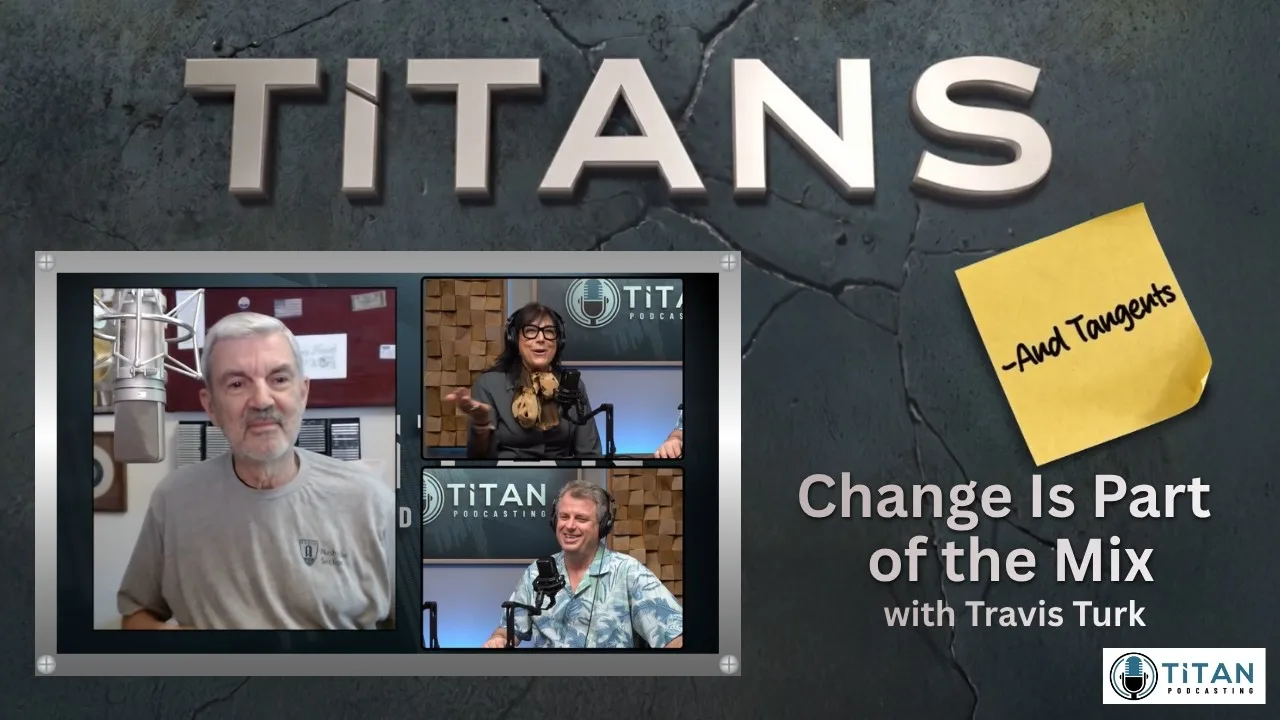
Change Is Part of the Mix
with Travis Turk
Travis Turk shares stories from decades in Nashville recording studios and traces the shift from analog tape and physical reverb rooms to digital production, remote mixing, and AI.
The full episode
Watch the full conversation
Playing the video connects to YouTube. Watch directly on YouTube
In this conversation
A guide to the subjects discussed.
- 01Recording history
- 02Analog and digital production
- 03Remote mixing
- 04Curiosity and career
Read the conversation
Full episode transcript
This transcript has completed Titan Podcasting staff review. Timestamps link to the source episode.
Read Full Transcript
- 0:00 on YouTube
Scott Kemp
Marki, you're not going to believe who we got on the show today.
- 0:02 on YouTube
Marki Costello
Well, Scott, call me curious. Who do we have on the pod today?
- 0:06 on YouTube
Scott
He's my good friend, Travis Turk from Nashville. This guy is an icon in the music industry, and I know you've heard his voice. Even if you don't think you've heard his voice, because he's also a voiceover actor, he's done voiceover for Ford and Coca-Cola and all that stuff.
You've heard his voice before, but he's also got tremendous accolades in the recording industry. He's recorded almost every major country music artist in the last 30 years. It's just outstanding. He's won lifetime achievement awards. We got to bring him on and talk to him. You're going to love him.
- 0:39 on YouTube
Marki
Travis, come on down.
- 0:43 on YouTube
Scott
Travis.
- 0:43 on YouTube
Travis Turk
I'm here.
- 0:44 on YouTube
Marki
I'm here. Well, Travis, I had a management company, creative management entertainment group, and I still have it. I just have a very small handful of people that I manage.
But the voiceover, my guy, Ethan, who's the voice of Toyota, I think he's been the voice of Toyota literally for 20 years, but talent would be like, "I just want to do some voiceover gigs." I'm like, "Okay, well, slow your roll.
You have a better chance of winning the lottery because the VO world is so tiny and the most coveted," and people don't get that.
- 1:16 on YouTube
Titans & Tangents theme: Titans and Tangents, step inside. Where leaders speak and heroes shine. Stories with purpose. Moments that climb. Titans and Tangents. Now it's time.
- 1:34 on YouTube
Marki
Are we back? We're back, and we're better than ever.
- 1:37 on YouTube
Scott
We're back.
- 1:37 on YouTube
Marki
We're back. So Travis, voiceovers I love, and my dad, who he's 87, he had a stroke two years ago, which is kind of what brought me to Oregon, but he was a record producer. He produced Dennis Wilson, the drummer of the Beach Boys, his whole album, "Pacific Ocean Blue." He produced a lot of Beach Boys songs.
So I was in a recording studio when I was five. And my grandfather was Lou Costello of Abbott and Costello, "Who's on first, what's on second, I don't know's on third." And Scott always says, "What the hell are you doing in Corvallis, Oregon, Marki?" That's a whole other story.
But yes, I love voiceover and music and engineering, and so Travis, welcome to Titans and Tangents. You are clearly a titan in your industry. Talk to us about where you are and how did you become this titan?
- 2:37 on YouTube
Travis
Thanks, Marki. Yeah. Well, currently I'm in Nashville, Tennessee. Actually just outside. But this is the whole big middle Tennessee, so I'll just say Nashville. Nobody knows where Mount Juliet is. Do you?
- 2:49 on YouTube
Scott
No, I don't.
- 2:50 on YouTube
Marki
No.
- 2:50 on YouTube
Travis
See? So I got started in this business back in... I didn't want to be in this business. I didn't start here. It was a hobby for me. I wanted to be, first of all, a television cameraman.
I thought that that was the coolest thing, and in high school, I used to draw cameras and pretend that I was doing the thing behind the camera, until I learned that he wasn't the director. He was listening to a director. I said, "Well, I want to be the director."
So anyway, I built a studio just to help my friends in the neighborhood, in their bands. We had lots of rock and roll bands when I was growing up. And I would record them just for fun, pure fun. I thought nothing about being in this business.
And I got the opportunity to come to Nashville in a recording studio when I was working at a radio station as a DJ. Boy, I've done a lot of stuff.
- 3:46 on YouTube
Marki
I like how you said DJ.
- 3:48 on YouTube
Scott
DJ.
- 3:49 on YouTube
Marki
Not Deejay. You said DJ.
- 3:49 on YouTube
Scott
He's got that golden voice, right? No wonder he gets—
- 3:52 on YouTube
Travis
Yeah, the old radio thing.
- 3:55 on YouTube
Scott
Give us a little radio promo.
- 3:57 on YouTube
Marki
WNBC.
- 4:00 on YouTube
Scott
Yeah, let's hear it.
- 4:01 on YouTube
Travis
Yeah. Oh, let's go to New York. How about, "CBS number one in New York. Welcome aboard."
- 4:07 on YouTube
Marki
Love it.
- 4:08 on YouTube
Travis
Let's see. So as I did all these little things, somehow they coalesced into what I'm doing today, which I'm still doing today at my age. I can't believe it. I should be retired. Everybody said, "You should be retired and spending all the money you've made." What money have I...
So I got started doing it in radio and television, and then came to Nashville to be in the music business and stayed here the longest of anything that I have done, and was fortunate to work with so many great artists. It was fun. So much fun to do this. It wasn't a job to me.
I couldn't wait to wake up in the morning and get downtown and open the studio and say, "Okay, who are we recording today?"
- 4:56 on YouTube
Marki
Right.
- 4:57 on YouTube
Travis
And it was a wonderful thing.
- 4:59 on YouTube
Scott
You've been in some amazing studios. You took me on a couple tours of some, I mean, where Elvis recorded and all this kind of stuff, right? That's where you worked.
- 5:07 on YouTube
Travis
Yeah. A lot of studios. I was an independent engineer for a long time, so I got to work at RCA and CBS and all of the big studios in town, and little ones. And although I built some, I built a place called Creative Workshop. It was a studio that Buzz Cason and I built, and it stayed there 50 years until his passing.
That's the longest probably of any studio single owner in Nashville, Tennessee. And it recently sold, and so the family got out of it. But that's how I got started in owning a studio in Nashville, Tennessee. And it was incredible. We were able to record all things from jingles.
In the mornings, we may do a Budweiser beer commercial, and then in the afternoons, we'd start doing demos, and then in the evenings, the afternoons, the evenings, we would record some of the bigger artists that wanted to spend all night making music.
- 6:12 on YouTube
Scott
Yeah. So, we've got some pictures of some of the artists that you've worked with, and it's basically the who's who of country music back then. And I was looking at some them today. I was like, "Wow." Do you have some of those pictures, Raul, we can bring up? Yeah, let's see some of those.
- 6:29 on YouTube
Marki
And what's interesting too, Travis, as we're getting the pictures up, studios, record studios now, they're selling, but because of the lineage or the people that have recorded there, they're really going for... They've become very, everything is old is new. Nostalgia is trending. It's so big.
I took my 87-year-old music producer father to see the Michael Jackson movie, and I loved it. Just because the music, I loved it. Just how can you not love it?
But, that studio in Encino, which was in the Jackson family home, so many people recorded there, and as a matter of fact, my dad went there 10 years ago and recorded with Brian May and Taylor Hawkins, who passed away, but he was the drummer of the Foo Fighters.
They redid a Dennis song called "Holy Man, Pacific Ocean Blue." Wow. Oh, Gwyneth. What was Gwyneth?
- 7:27 on YouTube
Scott
Gwyneth, yeah.
- 7:27 on YouTube
Marki
There's Gwyneth.
- 7:28 on YouTube
Scott
What was she doing there?
- 7:30 on YouTube
Travis
We were doing ADR for, what was their big series of movies? I'm blanking. And it was version two of it.
- 7:40 on YouTube
Scott
Gwyneth—
- 7:40 on YouTube
Travis
Anyway, she came, she—
- 7:42 on YouTube
Scott
What, Raul? Iron Man? Iron Man? Were you doing Iron Man?
- 7:45 on YouTube
Travis
Yeah. Iron Man 2. Yeah. She was in town for something, I don't remember, and we did some ADR, which is dialogue replacement for movies, and, for that film. Yeah, she was sweet.
- 7:58 on YouTube
Marki
Love that.
- 7:58 on YouTube
Travis
Great to work with.
- 7:59 on YouTube
Scott
So let's see the next picture of you in action. You look a little younger there, Travis.
- 8:04 on YouTube
Travis
There is a place called Sound Shop, and it was a two-studio complex that had all the latest equipment, as you can see. And, I was probably in my 30s in there.
- 8:18 on YouTube
Marki
Is that Robert Plant?
- 8:21 on YouTube
Scott
Next one coming up.
- 8:23 on YouTube
Travis
I captured that picture.
- 8:24 on YouTube
Marki
Iconic.
- 8:25 on YouTube
Travis
I posted it. Yeah. I captured that picture. I think I was about 62 years old, and he was about 58 or something, and I said, "Any questions?" I mean, look at him.
- 8:39 on YouTube
Marki
I mean, I know.
- 8:39 on YouTube
Travis
My goodness. He looks like he's 90 years old.
- 8:41 on YouTube
Marki
I know.
- 8:41 on YouTube
Scott
That's how you look, Raul, don't you?
- 8:44 on YouTube
Marki
Yeah. He lost his son. I just watched the documentary on Becoming Led Zeppelin, and it was fascinating because I just was actually listening to Led Zeppelin in my car. Who doesn't love a little Led Zeppelin? But yeah, these rock stars, they live very cray, cray lives. But yeah.
- 9:01 on YouTube
Scott
Let's see a few more, Raul. Here. Pop them up. Ted Danson.
- 9:04 on YouTube
Marki
Ted Danson. Oh, the great—
- 9:08 on YouTube
Travis
How about Howard Cosell?
- 9:09 on YouTube
Scott
Howard Cosell.
- 9:10 on YouTube
Marki
Howard Cosell.
- 9:10 on YouTube
Scott
Wow, Johnny Cash.
- 9:11 on YouTube
Travis
Yeah, Howard.
- 9:12 on YouTube
Scott
You worked with Johnny Cash.
- 9:13 on YouTube
Travis
I did, yeah. We were doing a... He was narrating a movie on A&E for, I think it was Roy Rogers. He was the voice on that A&E package.
Interestingly, my son started working with me at this studio, and Johnny's son came in sometime after I took this picture, and I said, "Hey, why don't you, my son, and Roy, and John's son, you all stand together at the same spot right there?" And I got it. It was just like two generations working together.
And somebody stole the camera, and I never got the picture.
- 9:58 on YouTube
Scott
Oh my God.
- 9:59 on YouTube
Marki
Now, let me ask you a question, Travis, because first of all, Nashville is like a little mini Hollywood. So many celebrities live there, so many musicians, so many people moved there during the pandemic, mid-pandemic. But, it's really a hub. But what about, is your studio mostly for ADR and voiceovers?
Are you mixing and engineering albums? Who comes to the studio primarily?
- 10:25 on YouTube
Travis
Well, first of all, let me explain that I am semi-retired. I don't go downtown to do music anymore. I do have a little record label, and most things I'm doing are at home, what's called in-the-box. I don't have a room where musicians come and play.
They send me their files from their home, their little studio, and I mix them together and distribute those from here. So, that is sort of a long-gone thing for me. But in the day, I retired maybe 20 years ago, from what I call driving downtown to studios.
And, oh man, we would have a room full of musicians most of the time to lay down tracks and go through the whole process in the analog days. And as it started to create and move into digital, what we call Pro Tools, all of that, it just sort of morphed over a period of that time to what I'm doing right now.
I'm staring at four screens here, and they're all the tracks.
- 11:26 on YouTube
Marki
Let's talk about that. Because, right, analog and then we went digital, Pro Tools. So many people say that was the beginning and the end of the music career. You know what I mean? Business in so many ways.
- 11:40 on YouTube
Scott
Of the big studios, anyway.
- 11:41 on YouTube
Marki
Of the big studios. What's your opinion on where we are with technology and AI, and just all of the things that these kids have in their hands that they're walking around with?
- 11:52 on YouTube
Travis
I just came from a meeting with about seven of us about AI and what we're going to do, but what's it all about and how can we live with it or without it? You know what I mean?
- 12:02 on YouTube
Marki
Well, we're not going to live without it. It's not going away.
- 12:05 on YouTube
Travis
That is very true. A lot of lawsuits going on right now about paying people for what they're scraping from, and I don't want to get into that technical stuff, but I think it's here to stay. There's no doubt about it.
It's a disruptor, just like, hey, I've been through several disruptors all through my life, all through my career. Analog to digital, that was a huge one. And it's still affecting us. People still want to try to record analog on old tape machines and old microphones, and they think there's some magic in all of that.
That's okay.
- 12:40 on YouTube
Marki
I was going to say, with the AI and what you were talking about, to piggyback off that, Taylor Swift, Matthew McConaughey, we're doing this with Lou Costello and the Abbott and Costello brand.
But it's really interesting with AI and trademarking and the legalities of it, because ultimately, we can do phrases like, "Hey, Abbott!" "Who's on first?" But you can't...
Taylor Swift just trademarked, "Hey, I'm Taylor," so that if AI went to go use, "Hey, this is Taylor," you would have to then get her permission, right? So it's really tricky and interesting, and there are so many lawsuits and so many people trying to protect their name, their image, their recordings. I don't know.
It's a devil we have to dance with.
- 13:30 on YouTube
Travis
Yeah. And I'm dancing with a little bit of it now just to see what it's all about, to learn about it, what it will do and can't do. Fortunately, I'm not putting any of my good stuff in there. I'm just throwing stuff in there just to see what it'll do. Because I'm afraid if it gets out there.
I produce Jimmy Buffett stuff, and I have a lot of masters here. I could take his voice and throw it out there and say, "I wonder what this would be like." Computer's got it.
- 13:55 on YouTube
Marki
Right. AI's going to take it.
- 13:57 on YouTube
Travis
Got his voice.
- 13:57 on YouTube
Marki
Yep. That's it. You've just let the devil loose.
- 13:59 on YouTube
Travis
Gotta be careful.
- 14:00 on YouTube
Marki
Exactly.
- 14:02 on YouTube
Scott
You kind of got Jimmy started with that, right?
- 14:03 on YouTube
Travis
Horse is out of the barn.
- 14:04 on YouTube
Marki
Horse is out of the barn.
- 14:05 on YouTube
Travis
I'm sorry?
- 14:05 on YouTube
Scott
Did you kind of get Jimmy started with his career, is that right?
- 14:07 on YouTube
Travis
I did. He and I are from the same town in Mobile, Alabama, and I brought him here, and we got into the studio overnight when the studio was available and recorded demos and had fun and said, "Well, what are we going to do? Well, let's see if we can get something going." And it was pure fun in those days.
It wasn't like a business to us. And so we recorded a lot of this, and I cobbled together about 10 or 12 songs and sold it to, Andy Williams had a record label at that time. And we sold it to his label, which was distributed by Columbia, which is great. That was his first album.
It didn't do very well, but it was a good start. And then we did the second album, and some weird things happened there. Andy sold the label. He didn't want to play in the business anymore.
And so, the masters quote, got lost, and he got very despondent because he was kind of hoping that that was going to be the launch point for his career. That's when he went to Florida.
He and Jerry Jeff Walker just jumped in their old Packard and went to Florida, and that's really where he gained his following, I think, the beginning of the Jimmy Buffett that we know.
But in the meantime, after about 10 years of him being gone, I called him up and I said, "Jimmy, I've got all these masters, these demos." I said, "You need to own those." I sold all those to him, and I said, "You know what would be nice?
Is to, let's get together and get about 10 of these songs, your beginnings, the first 10 things that you recorded. I'm sure your fans would love that." And he said, "I think you're right." Well, took another 10 years, but we finally got it in. It was called "Down to Earth," and it did very well.
Well, I'm currently working on "Down to Earth 2" right now, and they're saying it's going to be out in Christmas. We'll see.
- 15:59 on YouTube
Marki
The proverbial they. How dare they? So, what would you say, as a titan in this business, Travis, what would you say to the next generation sort of that has the same curiosity that you did, that you created this empire and being a titan in your industry? What would you say to the next generation coming up that—
- 16:19 on YouTube
Travis
Well, they're going to have to embrace AI, no doubt. It's a disruptor. It's happening. Everybody's doing it and talking about it, and that somehow, I can't vision how yet, somehow that's going to be part of the business. It's going to be, this is how they make music.
- 16:34 on YouTube
Marki
Right. 100%. What about social media? Is social media something you don't mess with or, because that—
- 16:42 on YouTube
Travis
I do. Yeah. I keep in touch with family and friends and that kind of thing and see what's going on in the world. But I'm not a heavy-duty user. I don't sit in front of it all day.
- 16:53 on YouTube
Marki
Yeah. Well, TikTok now, literally, they'll break an album. A song will go viral. It will start trending. People will do a dance, and the next thing you know, they're opening up for Justin Bieber. Meaning it's crazy how social media has changed the game. Same thing in show business.
Meaning, all of these business, show business, the movie business, TV business, music business, it's all changed dramatically. Back in, I would say 1985, if you voiced over a commercial, a national commercial, and that ran over and over again, you could literally make 200 grand in a year, 300 grand in a year.
Now they wild spot it. They chop it up for digital, cable. And you know that 200 grand, now you're lucky if you walk away with like 28 grand. But it's crazy how just, once again, the pie keeps on getting cut, cut, cut. But the business keeps on changing. But like you said it's the way it is.
- 17:50 on YouTube
Travis
That's the way it is.
- 17:52 on YouTube
Marki
It's evolution.
- 17:53 on YouTube
Scott
Travis, you are officially going to be our best-sounding call-in guest ever. That microphone right there, that's a Neumann, is that correct?
- 18:01 on YouTube
Travis
That is.
- 18:01 on YouTube
Scott
Is that a—
- 18:02 on YouTube
Travis
It's a Neumann U87 Ai. The Ai is the—
- 18:06 on YouTube
Scott
Is the classic?
- 18:06 on YouTube
Travis
That's the thing there, yeah.
- 18:08 on YouTube
Scott
They don't make that anymore, right?
- 18:09 on YouTube
Travis
It's the one that everybody wants. And I was lucky. I didn't understand the Ais from the Js and the K. I didn't know. And I bought it used, actually, from somebody in LA, and it's been great for me. It hasn't ever seen a factory back yet. I keep it nice and covered, and you just don't want to—
- 18:31 on YouTube
Scott
You can't buy those new today, right?
- 18:33 on YouTube
Travis
I don't want to lose this baby. It's wonderful. Yeah.
- 18:34 on YouTube
Scott
That's an old model. You can't buy that, right? Other than like—
- 18:37 on YouTube
Travis
You can, used—
- 18:38 on YouTube
Scott
—secondary market.
- 18:39 on YouTube
Travis
But not new. Yeah. Secondhand. Yeah.
- 18:41 on YouTube
Scott
What something like that go for?
- 18:41 on YouTube
Travis
That's how I got this one. Yeah. They're selling now from $4,000 to $6,000.
- 18:47 on YouTube
Scott
Oh my gosh. Yeah.
- 18:48 on YouTube
Marki
See, Scott, you're the titan. You own Titan Podcasting, and you get so into the mics and the cameras.
- 18:55 on YouTube
Scott
I love that stuff.
- 18:55 on YouTube
Marki
You love all of that stuff.
- 18:56 on YouTube
Scott
Travis took me for a couple tours in some of those studios in Nashville. They blow my mind. Some of the reverbs in the basements. When you think of reverb, you think of that reverb. They make it physically in the basement of some of these studios.
Travis, maybe talk about that real quick, the plate reverbs and how that's done.
- 19:17 on YouTube
Travis
Well, the very first reverbs that were on records... Actually, I'm going to take you all the way back to the very first time anybody ever heard. You remember Jerry Murad and the Harmonicats?
- 19:28 on YouTube
Marki
Yes.
- 19:29 on YouTube
Travis
They were very popular back in the '30s, I believe. And they were recording in Chicago, and the engineer at the time decided, "Man, this would sound great with some big reverberation."
So he took a microphone and went down the hall with the microphone and put it in the men's restroom and put a speaker in there, and the record you hear, you need to go back and listen to it now. That is a bathroom reverb. Well, that's how it started.
Okay, now studios start to build their own reverbs, and they build little rooms that they're not very big, usually about 10 feet long, maybe four or five feet by five feet. And you put a microphone and a speaker, and you got your reverb, and you can do as many of those as you want. Well, in Germany, a company called...
I can't think of it in the moment. I will in a minute. They took a steel plate that's four by six, a little thin, and they put a speaker on it and a pickup right attached to it and got this wonderful reverb, and that became the next generation of reverbs for recording studios.
And then when the digital era came along, they tried to make that sound like the... It's called EMT. That was the company I couldn't think of. The EMT plates. And now we have plugins that can imitate the Capitol Studios in LA's reverbs, the Motown reverbs.
All of those people that had built those rooms in their attics and closets and bathrooms and whatever are available to you. I actually have the EMI studio, the Abbey Road rooms.
- 21:11 on YouTube
Marki
The Beatles, London, Abbey Road.
- 21:13 on YouTube
Travis
The Beatles. I had an artist that was going to do a whole album of Beatle music, and I said, "Hey, I've got their plugins for compressors and microphones and EQs and everything." And he said, "Well, you know what? I think I can get Ringo's drums in my... I think I can get... And then the bass."
I said, "Hey, yeah, let's make it whole." I don't think we did anything that anybody would recognize, but it was fun to say that this is kind of an all Beatle-y, EMI, Abbey Road sound.
- 21:45 on YouTube
Marki
Love it. I just saw Ringo. God, Ringo looks great. He literally—
- 21:49 on YouTube
Travis
Doesn't he?
- 21:50 on YouTube
Marki
He does. He's a vegan. His lawyer is my lawyer. We share a lawyer, but he eats so healthy. He exercises, he meditates. But he looks phenomenal. Literally phenomenal. That's good clean living rock star versus—
- 22:05 on YouTube
Scott
Some of those guys age pretty quickly.
- 22:07 on YouTube
Marki
Yeah, Keith. Not like Keith Richards, who's walking dead. But Travis, well, you're a titan, and I'm so glad that you came and had some tangents with us about the recording business, the music business, AI. Anything else you want to add, Scott?
- 22:24 on YouTube
Scott
He's got a great story of Garth Brooks that I'd love to hear again, Travis. Do you remember that story you had?
- 22:30 on YouTube
Travis
Oh. Yes, I do. We were doing some promos for radio stations. "Hi, this is Garth Brooks, and you're listening to WXYZ and..."
- 22:39 on YouTube
Marki
WNBC, yes.
- 22:42 on YouTube
Travis
So there was pages and pages and pages of these. It'd take a couple of hours, you're sitting there, and most artists hated doing them. And he came in, and he knocked them all out, and he came in and, bright-eyed and bushy-tailed into the control room and he said, "Anything else?"
And a guy in the back room said, "My daughter is in the hospital in Kentucky, and she's going through some..." And his ears, I saw his ears perk up. He said, "Well, what's wrong with her?" "Well, she's got this and this and this." "Where is she staying?" "At St. Mary's in some town in Kentucky."
"Well, hold on a minute." Picks up the phone, he says, "Can you get me the St Mary's?" And he, on his own, with no prompting, called his daughter and said, "Hey, this is Garth Brooks, and I just heard about you. I'm so sorry you're going through this, and I just wish you well, and I hope you're going to do fine.
I'm sure you'll be home with your dad soon." And my heart just went, "I like this guy, man." This was a wonderful, wonderful thing he did. There are many stories like that I could tell, but that's one of the greatest.
- 23:47 on YouTube
Scott
That's cool.
- 23:47 on YouTube
Travis
Just makes your heart just— humans are great.
- 23:50 on YouTube
Marki
Yeah. It does.
- 23:51 on YouTube
Scott
In general, would you say dealing with those people, they're pretty down to earth? Because we don't ever have access to those kinds of people.
- 23:58 on YouTube
Marki
Speak for yourself, Scott. Speak for yourself, Scott.
- 24:02 on YouTube
Scott
I don't have that.
- 24:03 on YouTube
Marki
Yeah, you don't.
- 24:03 on YouTube
Scott
Raul doesn't have that. You might. Travis, would you say they're pretty down to earth?
- 24:07 on YouTube
Travis
I would say the majority are wonderful people to work with. They're not the kind of people that you might think are... What's the word I'm looking for? Where they got their nose up in the air at everybody.
- 24:24 on YouTube
Scott
Stuck up.
- 24:24 on YouTube
Travis
Stuck up. No, I would say the majority are wonderful people to work with. Only maybe 1% or 2% just don't, can't get along with anybody.
- 24:35 on YouTube
Scott
Yeah, you work with some big names. I'm going to say—
- 24:39 on YouTube
Marki
No, don't. I don't like—
- 24:41 on YouTube
Scott
Can I say a couple or not?
- 24:42 on YouTube
Marki
No. I don't. No, because I'm not from that. I don't like that. But yeah, I'm working with one of the biggest influencers in the world right now. They want to fly me out to North Carolina in two weeks, the 24th through the 5th of June.
But yeah, I mean, because my grandfather Lou, very generous, meaning he did everything for the kids.
When he made it big in Hollywood, right when he landed in New York and go to Paterson, New Jersey, he would rent a huge truck, go to five different toy stores, fill them up, and he'd hang off the back of the truck and just throw out toys to the kids.
Meaning, at Christmas time in LA, at their house in LA, the Longridge house, he had the studio build a train that went around his whole house and outside. But a train you could sit on, four people could sit on. People would line up. He'd dress up like Santa Claus.
He'd fill that train up with presents, and people would wait seven to eight hours just to drive by, get a picture, and get a present. So yeah, I come from that old school where it doesn't cost a dime to be kind, and most big A-list celebrities are lovely. You know who's the shitheads? It's the one that have no talent.
I say this all the time, I will coach the biggest names in the world in sports, in influencing, in interior design, fashion. They are lovely. They get the power of media training.
Or it's this young generation that's 20 that think they know everything because they think they can ask ChatGPT, "How do I become a music engineer? Here, ChatGPT outlined how I can do it. I don't need anybody's help." That's this young generation. And I just had this conversation with an agent earlier today.
He was like: "I want you to work with this guy." And I said, "I have no desire because I know exactly how it's going to go down."
- 26:38 on YouTube
Travis
Interesting.
- 26:40 on YouTube
Marki
But I think the old people that have been around, like me and Travis, I'm sure we worked with assholes, but the majority, I would say, have been lovely, right? And the more successful, the more lovely they are. It's really the insecure, less successful that are shitty. Can we say shitty on the pod?
- 27:02 on YouTube
Travis
I have one thought about it.
- 27:03 on YouTube
Scott
I don't know. Sounds good.
- 27:07 on YouTube
Travis
I remember when Taylor Swift came in for the first time. She had just gotten to town in Nashville, and she had a song. Her first record was called Tim McGraw. Most people won't remember that.
- 27:18 on YouTube
Scott
Remember that.
- 27:18 on YouTube
Travis
It was just a country song. Okay. So, Tim was in the studio at the moment doing a podcast, and we thought it'd be a cool idea if this young girl that just came to town would call in. So we had her call in, and, "Hello. Hey, Tim. This is Taylor Swift, and I just recorded a song called Tim McGraw."
And I saw the look on Tim's face. He's like: "Who's Taylor Swift?" He had no idea. But where I'm going is that she was sweet then, and she'd been in the studio several times after that doing promos and things, and she was nice. I thought she was great. And I look at her now and think, I don't think she's changed a lot.
- 28:03 on YouTube
Marki
No, I don't think so.
- 28:04 on YouTube
Travis
I think she's gotten more mature, of course. But I think she's cool.
- 28:07 on YouTube
Marki
Yeah. I know she gives back. I know she's one of the few artists, on her most recent Eras Tour, she gave back to the dancers, to the grips, to the people that are driving.
- 28:18 on YouTube
Scott
Yeah, that's probably not very common, right?
- 28:20 on YouTube
Marki
No, not common at all. The Teamsters, she was like: "Look, if I made $1 billion on this tour, I want you all to make X amount of dollars." And so, like I said, I think the bigger, they really are good.
It's really just the people up-and-coming that have a little success, that maybe they have one or two hits, and they just, yeah, they get an ego, and they're less generous and sweet until they get knocked down five pegs.
- 28:39 on YouTube
Scott
Pretenders almost.
- 28:51 on YouTube
Travis
Not like you and I.
- 28:52 on YouTube
Marki
No.
- 28:52 on YouTube
Travis
No, we're great, right?
- 28:54 on YouTube
Marki
We're great. We're great. Ba-dum, ba, ba, ba, ba. We're great. Love it.
- 28:58 on YouTube
Scott
That's awesome. Thanks, Travis, for coming on today. It's good to hear your voice.
- 29:03 on YouTube
Travis
Well, thank you for having me. This was fun. It's a lot of fun. I'll remember this for a long time.
- 29:07 on YouTube
Marki
Oh, well, good.
- 29:08 on YouTube
Travis
A lot of fun, special.
- 29:08 on YouTube
Marki
We want to be memorable.
- 29:08 on YouTube
Scott
He'll remember you, probably.
- 29:10 on YouTube
Marki
We like to be memorable.
- 29:11 on YouTube
Scott
Not me. Unforgettable.
- 29:11 on YouTube
Marki
Yeah. Unforgettable. Now mix that up for us, Travis.
- 29:17 on YouTube
Travis
It's what you are. Every time.
- 29:21 on YouTube
Marki
We'll do a little duet right now. Travis, let's do a little duet.
- 29:23 on YouTube
Scott
No, the timing's going to be off. You guys will sound terrible.
- 29:25 on YouTube
Travis
Yeah, it's way off. You're really weird.
- 29:27 on YouTube
Marki
Oh, God. Killjoy, killjoy. See?
- 29:29 on YouTube
Scott
I'm sorry. I'm just calling out—
- 29:29 on YouTube
Marki
He goes right from that tech we'll do it in person.
- 29:30 on YouTube
Travis
We'll do it in person one day.
- 29:31 on YouTube
Marki
Well, Travis, it was a blast to have you on the pod. You're a titan. And we had a lot of fun tangents. Scott, always a pleasure.
- 29:40 on YouTube
Scott
Thank you, Marki.
- 29:40 on YouTube
Marki
And we will see you next time on Titans and Tangents.
- 29:45 on YouTube
Travis
Titans and Tangents.
- 29:45 on YouTube
Music: [upbeat music]
Your next recording