Full conversation
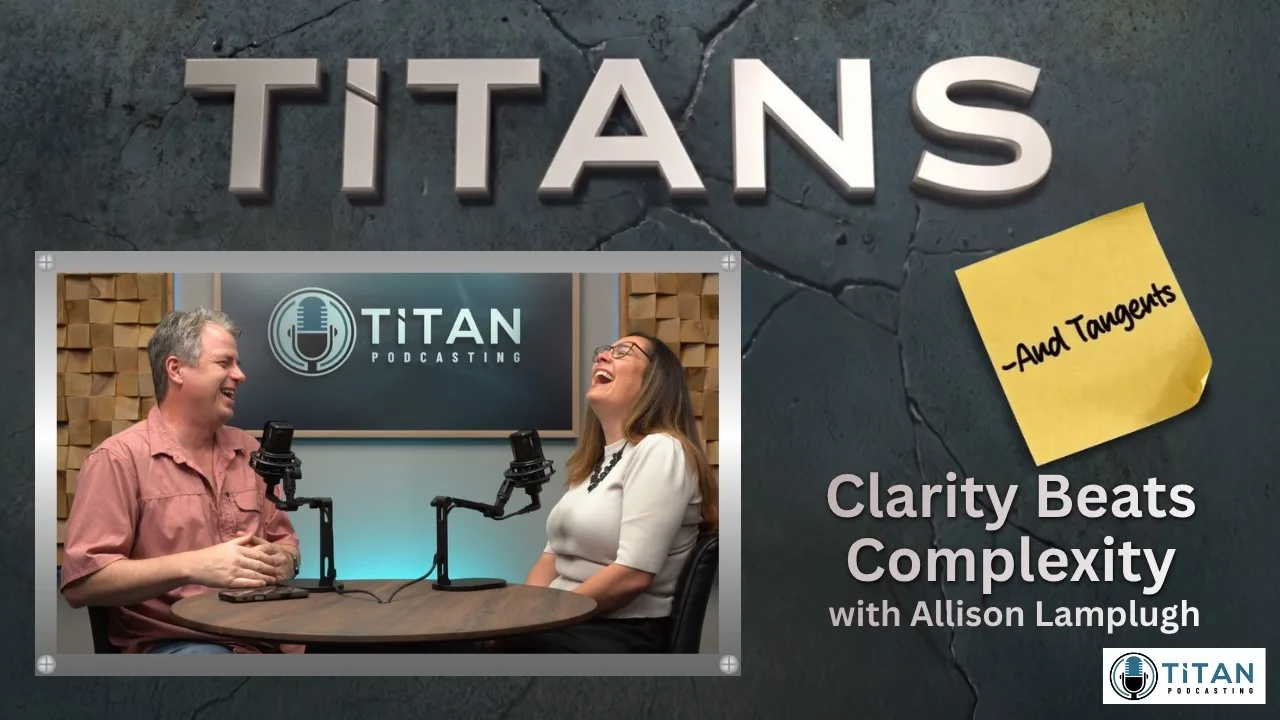
Clarity Beats Complexity
with Allison Lamplugh
Allison Lamplugh shares practical ways to make marketing clearer, from coordinating websites, branding, SEO, and advertising to responding to AI-driven changes in how people search.
The full episode
Watch the full conversation
Playing the video connects to YouTube. Watch directly on YouTube
In this conversation
A guide to the subjects discussed.
- 01Marketing priorities
- 02Websites and SEO
- 03AI and search
- 04Brand clarity
Read the conversation
Full episode transcript
This transcript has completed Titan Podcasting staff review. Timestamps link to the source episode.
Read Full Transcript
- 0:00 on YouTube
Scott Kemp
Every business owner knows they need marketing, a better website, stronger branding, social media, photos, videos, ads, SEO, but managing all of it can quickly become a full-time job. That's where Allison Lamplugh comes in.
As the founder of Lamplight Creatives in Corvallis, Allison helps small businesses bring the right creative pieces together, connecting them with designers, writers, photographers, web developers, and marketing specialists, without making the owner manage the whole puzzle alone.
Today, I promise you, you're going to learn something new about marketing, what works and what doesn't, and why so many businesses make it harder than it needs to be. I'm your host, Scott Kemp, and this is Titans and Tangents.
- 0:41 on YouTube
Titans & Tangents theme: Titans and Tangents, step inside. Where leaders speak and heroes shine. Stories with purpose. Moments that climb. Titans and Tangents. Now it's time.
- 0:58 on YouTube
Scott
Allison, thanks for coming on.
- 1:01 on YouTube
Allison Lamplugh
Thank you for having me.
- 1:02 on YouTube
Scott
Oh my gosh. You're like a superstar in the marketing world, in the area. You help so many people solve difficult problems, right? Because marketing for a lot of people is a dirty word. Both because it costs money, and because they don't understand it. But they kind of know they need it, right?
- 1:19 on YouTube
Allison
Yep. Absolutely.
- 1:20 on YouTube
Scott
So, talk to me about what you've created here with Lamplight Creatives.
- 1:24 on YouTube
Allison
Yeah. So, we are actually going on our seven-year anniversary next month.
- 1:29 on YouTube
Scott
Seven. Nice.
- 1:29 on YouTube
Allison
So I'm pretty excited about it. I actually, for half of the year, thought that it was our six-year anniversary, and then had to do some back math and was like, "Time really flies."
- 1:38 on YouTube
Scott
See, that would get you in trouble if you were married. Trust me. I've tried that once or twice. It did not work out well.
- 1:45 on YouTube
Allison
Yes. Well, luckily Lamplight forgave me.
- 1:49 on YouTube
Scott
Okay, good.
- 1:49 on YouTube
Allison
And we're back on track at seven years. But, time really has flown by. It's a whirlwind. I opened about six months before the pandemic.
- 2:00 on YouTube
Scott
Oh, that's a great time.
- 2:02 on YouTube
Allison
Yeah. It really was. I cannot complain. I'm one of those businesses that was like, "Business is great. How are you?" And they're like, "Uh..." I'm like, "Ooh, I should probably not be too excited."
- 2:11 on YouTube
Scott
I signed a lease on an office two months before the pandemic, and then they shut everything else. Oh my gosh.
- 2:17 on YouTube
Allison
Yeah. I originally had thought I was going to do a hybrid. I had a co-working space in town. People were going to come in. I had a conference room.
And that worked great for the first couple months, but the pandemic really pushed me into the virtual space, as with many of us, and I didn't go back because I really enjoy the efficiency of working virtually. And especially when I've got now, I don't know, 20 or so people in the network with skill sets.
Not all of them are right next to me. Not all of them are right down the street. I would say probably 80% of them are in Oregon and locally in this area. But, it just makes things easier. Plus, we can serve people anywhere. So, yeah, I've remained virtual.
- 2:59 on YouTube
Scott
So, talk to me about this construction that you've made with... You're kind of the head person, right? You're the glue. And you're taking all these pieces and putting them together to solve a problem. Is that right?
- 3:10 on YouTube
Allison
Yeah. Some people liken it to being a creative contractor, and I think that that is fair, where I know the people with the skills.
And I meet with all of the clients, and sometimes I meet with a client, a lot of times, for branding and just feel like, "Oh, I know the graphic designer that would be a perfect fit for this person." Whether it's their particular style or their background or whatever it is.
And so that's kind of fun to pair creatives if it's outside of my skillset with someone. But yeah, that's really what it looks like. When I was working in marketing previously, before starting my business, I would meet with business owners, business leaders through that role.
- 3:49 on YouTube
Scott
Was that like you were an employee or was it your own business?
- 3:52 on YouTube
Allison
Yeah. No, I was an employee. And I had to go out into the community and make these connections with spaces because we were renting out spaces to bring in classes. And so I was meeting all sorts of people in different areas.
And after, I would take off my hat from whatever meeting I was there for, people would say, "Hey, I have a question for you. I have this project. My boss threw it on my desk. I don't know where to go. I don't know who's good. I don't know what they're saying when I get there."
Sometimes when you go to a print shop, and they have very specific questions, just that is overwhelming about what words they're using.
- 4:25 on YouTube
Scott
That's right.
- 4:25 on YouTube
Allison
And so I started hearing these things over and over again and thought, "Really what I'm hearing is there's a void for one place that someone can go and talk to one person." That was the other thing.
It's like the rep changes, and now I'm repeating my story again, or that person is off, and now today I have to explain to this other person I've never talked to why it is that I'm calling.
And so I put together all of those things that I heard and thought, "Okay, if I'm the one person that everybody talks to, then I know everything that's happening, the parts of the project.
And if we're one spot, and I have all these people behind me with a skillset, then they don't need to run around town and talk to different places and different people." So, that's how the agency began, and I believe I launched with nine creatives in the network.
- 5:11 on YouTube
Scott
Okay. How did you find them?
- 5:12 on YouTube
Allison
They were all people that I'd worked with previously in some capacity, whether they were a website developer or they created logos. I had all of these different people that I knew just because I worked in the industry, and I made it pretty easy for people to just say, "Yes, sure. Absolutely.
If you get a job and you want to pass it to me, I would love to work with you." And that's really what it looks like. And it also takes the client out of a lot of conversations because me and the creative can talk about, "What are we going to present to the client if it comes to a logo?"
- 5:44 on YouTube
Scott
Right.
- 5:44 on YouTube
Allison
"We're going to decide on these five concepts together," and they don't have to go through that process. And then we present to them, and we move on from there. And that is another thing that I heard was, "Hey, I already have a full-time job, and I've been told I need to do this by whoever assigned it."
"And I don't have the time." So again, trying to save time for other folks. So, it's been a learning process, but that was the concept we began with.
- 6:09 on YouTube
Scott
And now you're up to, you say 20 or so, right? And we're one of them. I have a brand, Cinematic Solutions, and we've done a lot of video work for you.
- 6:15 on YouTube
Allison
We have.
- 6:16 on YouTube
Scott
Thank you for that. That's awesome.
- 6:17 on YouTube
Allison
Thank you.
- 6:18 on YouTube
Scott
Yeah. We just did headshots for you as well with our Headshot Heroes brand.
- 6:22 on YouTube
Allison
Mm-hmm. Great.
- 6:24 on YouTube
Scott
But you work with a lot of nonprofits, right? Talk to me about that. That was one of our co... What do you call that? Collabs—
- 6:31 on YouTube
Allison
Yes.
- 6:32 on YouTube
Scott
—I guess, that we did with you.
- 6:33 on YouTube
Allison
That we did. Yeah. It's interesting. We don't have a particular kind of business that we serve. I wouldn't say there's a niche. I'd say everything falls in the small to medium size category, which is my goal.
First, a lot of really large size companies have internal marketing teams, and so they don't need an extension of themself, which is what I really act as for a lot of those smaller businesses.
But yeah, with those local businesses we're serving, I would say that nonprofits take a good percentage, maybe a third of them are nonprofits, and that's always really interesting. One of the things with a nonprofit is you get money from grants and things that you've applied for and you have to spend it.
It's not like you're sitting on it in the bank. And so a lot of times they'll—
- 7:17 on YouTube
Scott
That'd be a weird problem to have.
- 7:19 on YouTube
Allison
Right, yes.
- 7:19 on YouTube
Scott
I want that problem. You have to go spend this on...
- 7:22 on YouTube
Allison
Yeah. Have to do it. You have deadlines. Sometimes they're like "We want to do this, and we need you to invoice us before this day." And I'm like, "You realize we're not going to be done for three months, right?"
- 7:30 on YouTube
Scott
I need to make a nonprofit. Maybe that's my problem. I need to make a nonprofit so I can become rich. No, I'm just kidding. That's very interesting. So, how long have you been in Oregon?
- 7:44 on YouTube
Allison
Well, I was born and raised here. I moved away when I was 17 and was gone for 14 years.
- 7:49 on YouTube
Scott
Okay, where'd you go?
- 7:51 on YouTube
Allison
In California. For the most part. I was in the Bay Area for a large portion of it. The last four or five years I was in Southern California, and Hollywood specifically. And I took a little stint to go to Nashville and Vegas in between those times.
- 8:04 on YouTube
Scott
Which of the three did you like the most? Vegas, Nashville, or California?
- 8:07 on YouTube
Allison
Southern California. Yeah. I love the weather. I love the speed of things. I love that there's always stuff to do. I love that it's fashion forward. There's just like a bunch of—
- 8:19 on YouTube
Scott
Fashion? What's fashion?
- 8:20 on YouTube
Allison
Yeah. We got things before a lot of other places did. I remember coming home sometimes here, driving here and having things that other people hadn't seen before. Just as simple as like a BlackBerry phone. We had BlackBerrys for at least a year in Northern California before they were out of the market.
Tesla, he tested a lot of things back in the day in the West LA area where I worked. So we kind of would see these cars driving. It was just really fun. So, I would say that's definitely... I left a little bit of my heart there.
- 8:54 on YouTube
Scott
Is it the song, "I Left My Heart in San Francisco?" Is that the one?
- 8:57 on YouTube
Allison
Yes, I did hear that in my head when I said it.
- 9:00 on YouTube
Scott
I just went to San Francisco like a month ago. There was a printer for sale on Facebook, and it was a large one. And they're normally like, lots of thousands of dollars. And it was like 80% off on Facebook Marketplace. But it's in San Francisco. And so I called my buddy Rich, and said, "Let's go get this printer.
Want to do it with me?" And so we did a 24-hour trip with 20 hours of driving. But we came back in 24 hours.
- 9:29 on YouTube
Allison
Wow. Whoa.
- 9:29 on YouTube
Scott
So we went down to San Francisco, went over the bridge. It was $40 to go over the bridge and back for tolls. $20 over, $20 back.
- 9:36 on YouTube
Allison
Oh, wow. I didn't realize it had gone up that much.
- 9:39 on YouTube
Scott
So we buddy drove. Buddy drove, I'd sleep and he'd drive, and then I'd drive and he'd sleep.
- 9:46 on YouTube
Allison
Road warriors, for sure.
- 9:50 on YouTube
Scott
I haven't been to California in probably 10 years before that.
- 9:53 on YouTube
Allison
Yeah. I haven't been back in probably five or six years. And last time I was there, I was in LA, so I haven't been to the Bay longer than that. So, yeah.
- 10:04 on YouTube
Scott
Yeah. So, tell me why businesses... The marketing is kind of, like I said, it's almost a bad word because they know they should be doing it but it costs money. They don't know how to do it. Why do they fear that? Because I feel like they don't spend enough money on marketing.
They just hope it just comes to them organically, or they just pop up a website, and it's just going to feed them for the rest of their life, and that's not true, right?
- 10:31 on YouTube
Allison
Yeah. No, not in most cases. Unless you've got a product that everybody has just never seen before, and you're the only one selling it, there might be a little bit of an outlier there. It does take a little bit of money to make money when it comes to marketing.
- 10:45 on YouTube
Scott
That's right.
- 10:45 on YouTube
Allison
It is true.
- 10:47 on YouTube
Scott
People don't realize that.
- 10:48 on YouTube
Allison
Yeah. And, I think part of it is, when you first open your business, there's so many moving parts. I definitely know that. I know that you know that. And you're so focused on all of those logistics that sometimes the marketing piece gets missed because you've just spent X amount of time getting all the things together.
- 11:06 on YouTube
Scott
Mm-hmm. The back end, right? The product or whatever.
- 11:08 on YouTube
Allison
And then I think, just my observation is it ends, and it starts to go into a little bit of complacency, where things are going, we're trucking along, we're paying our bills. And then it gets to a point where you start to recognize that there's not the growth, or there's competitors
- 11:24 on YouTube
Scott
That's right
- 11:24 on YouTube
Allison
that see what you're doing or just happen to be doing something similar. And so it takes a couple of years sometimes for people to get to that point. And then when they come, they kind of have a pretty good idea of at least some of the goals that they would like to achieve.
And whether they know how they're going to do them is another thing—
- 11:42 on YouTube
Scott
Yeah. That's right.
- 11:43 on YouTube
Allison
—that's where I come in. But...
- 11:45 on YouTube
Scott
So, when a client comes to you, why are they coming to you? They want more sales, they want more visibility. What's pushing them over the edge to give you that call, and how do you know what to do with them?
- 11:58 on YouTube
Allison
Yeah. I would say a lot of times, businesses that say, "Hey, I threw together my website overnight, and I get a lot of feedback on things that aren't working well, and I just don't have the skill set to do it." And so a website project can lead to a lot of cool things.
If you need product photography, if you need videos on the page or various things. And so those are always nice because there's usually multiple parts. I think another thing that I hear is, "I don't see myself in Google. When I do a Google search, I'm not on the first page of results."
- 12:29 on YouTube
Scott
And their competitors are, right.
- 12:30 on YouTube
Allison
And their competitors are. And I would say that that's a really common one that I hear. And normally, if I look at their website, from an SEO perspective, search engine optimization, I can already see some things that might be causing some of that. And so then it's a conversation about that. Or...
products that they need to move quickly. There's a sale. They're no longer going to be selling this thing. It's seasonal, whatever it is. And then Google Ads sometimes will come into the question there.
- 13:01 on YouTube
Scott
Yeah. So you do ad buys for people, is that right? So, what are you most known for as far as the different types of marketing that you can do?
- 13:13 on YouTube
Allison
So, during the pandemic for about the three years, we were building at least five websites at a time for probably all of that time. So, I would say when we first started, I was more of a website development agency even though I didn't expect that that's what it was going to be.
I would say that that has shifted, and it's interesting if you look at the market. So everybody got online because they realized they needed to be online. There were businesses that were operating for 10 years that didn't have a website. They didn't need one. Their customers came in. They were loyal, all these things.
So then everybody gets online, and then everybody realizes they need to start competing. So for the last couple of years, I would say that the biggest sales have been in search engine optimization and Google Ads.
And really looking at that progression, it's like, yeah, everybody got what they needed, now they're trying to compete for rankings.
I would say the most surprising part of the business that I actually didn't write into my business plan was consultation services, and I actually enjoy that very much, where I actually am on retainer for a handful of clients.
And I go to work for them on very specific projects that are usually longer term projects, and they keep me as a virtual extension to kind of work on those things.
- 14:29 on YouTube
Scott
Keep it on the rails, right?
- 14:31 on YouTube
Allison
Yeah, and I've had one client that's had me for now for five or six years on retainer, and so I know a lot about their business and the different departments, and support those departments when they need them. So that's been a fun addition that I didn't kind of see, but again, I heard.
People were like, "What if I just had you around for when I needed something?" And it's like, "Oh, yes."
- 14:50 on YouTube
Scott
A marketing expert in their back pocket. So that's cool. So, there's a couple things that are really taking over, and that's AI and social media. Let's hit AI first. How is that changing what you're doing?
- 15:04 on YouTube
Allison
Yeah. First of all, I'm not worried about AI taking my job. That's the first question that people say is, "Oh, are you feeling it encroaching on your work?" Well, certainly it's being incorporated into our work. I think that there's some really exciting things that are happening with that.
There's also some things that are a little scary, like people that say, "I wrote all of my website content with ChatGPT," and that just brings me anxiety immediately.
- 15:33 on YouTube
Scott
They kind of all tend to look alike. You can tell those AI-generated websites.
- 15:36 on YouTube
Allison
And it's not a natural human cadence. There's actually cheat codes you can put in to things like ChatGPT now to make it sound more natural.
But one of the problems that we actually saw, I believe it was April of 2025, Google made a big rollout on their algorithm, and it was to go and find content that was borderline plagiarism on the website.
And we had a people that were calling saying, "I used to rank number one, and now I'm not even there, and we don't understand. Literally overnight, we lost our rankings." And I would ask questions about, "Well, what kind of content? Where did your content come from?"
And if it comes from something like ChatGPT, that's an opportunity to educate that ChatGPT uses pieces of things that already exist. It's generally not creating 100% unique content. It might rearrange the way it's formulated.
So when you start stacking that on top of stacking that on your website, then you hit a threshold of potential plagiarism, and Google says, "Nope," and you stop showing up in results.
So I've had this conversation with people multiple times over the last year or so, to just kind of help educate on how we can use tools ethically and not harm our business in the long run.
- 16:57 on YouTube
Scott
Yeah, nobody wants that.
- 16:58 on YouTube
Allison
We're all learning. These people didn't do it on purpose.
- 17:01 on YouTube
Scott
I remember when I built a fishing lodge in Alaska in 2005, and then we were operational in 2008. And I worked on the website for that, and we got penalized by Google. And they'd put you in the penalty box where they'd add like plus 50 to whatever you were. So if you were on number three, you're now on number 53.
So it was a big penalty, and it was duplicate content back then. So they would see that a page was identical. You were trying to spam the engine, and it's the same content. And nowadays, I think Google could realize as well, we're just going to pick one.
It's probably the tool that did that, or you're supposed to tell it this is the canonical version, and this isn't right. Back then, I paid $2,000 for somebody to help me figure out why my rankings just hit the tank, and because Google won't tell you. Because they don't know if you're a scammer or a legitimate business.
And so if they tell you "Hey, it's because you did this," and you're a scammer, you just adjust your tactics. So they're not telling you anything. It's a black box. All you can do is plead for forgiveness. You go in there and say, "Oh, I'm so sorry I did this. This is exactly what I do."
And it's kind of funny because you start confessing all your potential sins like "I might have added one extra keyword here." I'd love to go in the Google end of that and just see this list of confessions. You're like, "No, that wasn't it, but that was interesting.
And that's not it, but that was interesting you did that, too. I'm going to look at that."
- 18:28 on YouTube
Allison
That's funny. Mm-hmm.
- 18:29 on YouTube
Scott
So, we had a consultant come in, and they found some duplicate content, and we got rid of it, and then asked for forgiveness to the Google gods, and they forgave us. We're back.
- 18:41 on YouTube
Allison
Yeah. Absolutely. And there's so many things, and it's changing so quickly. I mean, just over the last year, what we've seen come up and the capabilities.
- 18:48 on YouTube
Scott
Oh my gosh, yeah. The fact that AI is now that top slot, right?
- 18:52 on YouTube
Allison
Yes. Above the organic rankings, right? So now you're changing—
- 18:55 on YouTube
Scott
Above even the map pack, right? So it's AI first. So how do you get ranked in that? I mean—
- 19:01 on YouTube
Allison
So it's changing the way— So SEO traditionally is just SEO, but now it's AI SEO, and it's a specific tactic. We actually spent, my SEO team, about a year reverse engineering how AI is grabbing information from the internet. Perplexity and Grok and ChatGPT, all of those. And it's changing what SEO means.
So now, instead of just trying to rank in rankings, which you still can do, you really need to be ranking for trustworthiness. It's called EEAT, E-E-A-T, signals. And you need to rank for that for AI to want to grab your content and cite you in overviews.
Or for somebody to ask a question into something like ChatGPT, "Where is a local marketing agency I should trust?"
- 19:48 on YouTube
Scott
Right.
- 19:49 on YouTube
Allison
If you're doing these AI SEO tactics.
- 19:51 on YouTube
Scott
Because that's what people are doing nowadays. I'm doing it.
- 19:53 on YouTube
Allison
Yes.
- 19:53 on YouTube
Scott
I'm not going to necessarily Google anymore and asking it. If I do, there's a good chance I'm going to look at its AI result. But I'm going to ChatGPT and what's the best marketing agency, like you said.
- 20:04 on YouTube
Allison
Yeah, and it's definitely working. I'm seeing it in our analytics. Every month I see, "Oh, this came from ChatGPT. This came from Perplexity."
- 20:11 on YouTube
Scott
Fascinating.
- 20:11 on YouTube
Allison
I see that it's referring people. So it's interesting. So yeah, it creates an opportunity for a new service, which we've now launched. You've just got to run with it. You've got to pivot with it. We're always changing. It's constant, right? It's the one thing guaranteed.
- 20:25 on YouTube
Scott
Yeah, because they release updates to their algorithm every few months, right?
- 20:29 on YouTube
Allison
Oh, yeah. I mean, sometimes they literally update the algorithm daily. Not the big, huge roll-outs, but yeah, the roll-outs are happening consistently throughout the year. And so it's somebody's job just to continue to stay on—
- 20:40 on YouTube
Scott
It's a little bit scary how quickly it's changed, right? I mean—
- 20:44 on YouTube
Allison
Yes.
- 20:44 on YouTube
Scott
—this wasn't a thing a year and a half ago.
- 20:46 on YouTube
Allison
Literally.
- 20:47 on YouTube
Scott
It was not a thing.
- 20:48 on YouTube
Allison
It was not a thing.
- 20:48 on YouTube
Scott
Now it is, like, the biggest thing. I heard that a year ago, 6% of traffic was coming from the AI results, and now it's 40%, where people are just reading that and not even going to websites.
- 21:02 on YouTube
Allison
I read something last week. It's 50% now.
- 21:05 on YouTube
Scott
Oh my.
- 21:05 on YouTube
Allison
It's estimated 50% of people don't even click. They're calling it zero-click SEO. There's an actual name for it now—
- 21:12 on YouTube
Scott
Oh my gosh.
- 21:13 on YouTube
Allison
—where you have no need to click through to a website because it just gave you your answer.
- 21:15 on YouTube
Scott
And Google loves it because you stay on Google.
- 21:17 on YouTube
Allison
You are on Google.
- 21:18 on YouTube
Scott
And you're getting Google ads—
- 21:21 on YouTube
Allison
Yes. Yeah.
- 21:21 on YouTube
Scott
—if you're not using ad blockers, which you should. I might use a little bit of ad blocking. How does social media fit into what you do?
- 21:30 on YouTube
Allison
Yeah. I would say mostly I'm helping coach people on how they can manage their social media accounts. We definitely run Meta Ads, and we've run Pinterest ads for people before. If you have a really feminine-based brand, that's a great place to be.
- 21:47 on YouTube
Scott
Yeah, Pinterest is like that.
- 21:48 on YouTube
Allison
Yeah, it's like 70% female users, so it's a very specific audience. But I would say it's a lot about coaching people on how to make sure that they can at least start going outside of their network to talk to people. But especially Meta has adopted a lot of the SEO tactics.
Like hashtags are actually not really a thing that's necessary anymore on things like Instagram and Facebook. Because they're actually reading content in captions and distributing it that way. So I think in even some of the accounts, they're not even allowing more than five hashtags to be used, and it used to be 30.
- 22:25 on YouTube
Scott
Thank goodness. Hashtags were such a pain. You never knew which ones to use and what was trending. It was just a pain.
- 22:32 on YouTube
Allison
Yeah. Well, and you could also get flagged from using trendy hashtags if they were in a post that didn't actually relate to the content. So then there's all of that. I mean, I've done—
- 22:42 on YouTube
Scott
So you can't make an oil change SEO thing and just say #cutekittens in them?
- 22:47 on YouTube
Allison
#labsofinstagram. I actually had a client who got reported for spam, essentially, because #labsofinstagram is a huge hashtag with millions of followers, and they were using it every time they made a post that was totally unrelated. It was about their business.
And their account got frozen because they were like, "I don't know. Is this a real per-" So yes, you said something about kittens, and it was like, "Oh, this actually reminds me." So.
- 23:17 on YouTube
Scott
Social media's here permanently. The younger generation, that's what they do. They're going to Instagram. They're going to probably not even Facebook anymore. They're going to Instagram, they're going to TikTok. And they're doing their searches there, which is crazy to me.
I was in the industry when the web started, so early '90s. And we used a search engine back then called AltaVista. I don't know if you remember that one. But that was the Google back then. That was the monopoly. Everybody used that.
And then Google came along and whooped their butt, but people were like, "How do we break up AltaVista?" They were the only ones. And so anyway, but now that's the generation I come from, is to go to a search engine to do a search, right?
People are now going to Instagram to do a search or TikTok to do a search on best food in Corvallis on TikTok. And that blows my mind.
- 24:15 on YouTube
Allison
Because it's consumer-centric.
I think that's the one thing, especially with younger generations, is there's so much being told about what you should think and where to go to look for things, that asking for opinions on social media about the best X, Y, or Z feels a lot more comfortable for them than opening up Google and knowing that the first seven people paid for placement.
Like they may not be the best. They might be, but it's your job, then you have to go and research it. And so yeah, there's actual stats that, Gen Z—
- 24:49 on YouTube
Scott
Or what's crazy to me is they'll do a post on TikTok asking people what's the best—
- 24:53 on YouTube
Allison
That's correct. Because those are real people that didn't get paid to tell you that it's the best, they just love it.
- 24:56 on YouTube
Scott
So weird. And then they'll comment back and you read their comments. It's like, "Hmm, I'm getting old." "I'm out of date." "I'm rusty, held together by duct tape and zip ties," so.
- 25:10 on YouTube
Allison
Well, and what's interesting about social media is every couple of years we have a new platform that pops into the scene. Sometimes they make it, sometimes they don't. But the group of users stays with the platform. So when we look at Facebook, Facebook has the largest group of 55 and up users.
Well, those people were 30 and 25 when Facebook came out. They just stayed with it. So that's why that population is there.
- 25:34 on YouTube
Scott
Aging.
- 25:34 on YouTube
Allison
Instagram's going to start to grow in their population.
- 25:37 on YouTube
Scott
They have to do the same thing, I guess, right?
- 25:37 on YouTube
Allison
Like, right. Already—
- 25:37 on YouTube
Scott
And so new will come.
- 25:39 on YouTube
Allison
Yeah. Well, TikTok just moved into the biggest group, is 24 to 35 now. Last year it was like 18 to 24. But we've got some people that are starting to age. It's been around.
- 25:48 on YouTube
Scott
So the question is what's going to be the next one that comes, right?
- 25:50 on YouTube
Allison
Right. Yes. And they set a lot of those trends, those younger audiences, so.
- 25:57 on YouTube
Scott
So you're doing a lot of new media marketing. Are you doing any, what would be called old school marketing at all?
- 26:03 on YouTube
Allison
Like print marketing and such?
- 26:06 on YouTube
Scott
Yeah. Print, yeah.
- 26:06 on YouTube
Allison
I would say definitely not as much, but there are still a time and a place. I do have one client that I work with that we place regular ads in newspapers—
- 26:18 on YouTube
Scott
What's a newspaper?
- 26:18 on YouTube
Allison
—across the counties that they serve.
- 26:21 on YouTube
Scott
What? It's the Yellow Pages.
- 26:22 on YouTube
Allison
Yes.
- 26:24 on YouTube
Scott
I love those YouTube videos or whatever, when the people like me show their kids, "Do you know what this is?"
- 26:29 on YouTube
Allison
Yes.
- 26:30 on YouTube
Scott
Like a rotary phone. Like, "How do you use this?"
- 26:32 on YouTube
Allison
Yes.
- 26:33 on YouTube
Scott
I don't know. Like hold it up to their ear or whatever.
- 26:33 on YouTube
Allison
I love that. I just saw one of those, and the dad was behind the camera asking his 16-year-old daughter five words from the '90s or phrases, and what they meant. And one of them was what a collect call was.
And it was really interesting to watch her answer, because she just kind of looked and was like, "Well, it sounds like you would gather a bunch of people and everybody would get on the same call."
- 26:55 on YouTube
Scott
Oh my God, it's a collect call.
- 26:56 on YouTube
Allison
And it's like, that makes total sense. And also if you think about a group text, she's probably thinking in like what would you do today when you're collecting... Anyways, it was, yeah, it was fun to watch.
- 27:04 on YouTube
Scott
There's so many people alive today that have never used a phone booth, right? Never dropped a quarter or a dime back in my days into a phone booth. That literally put that entire industry out of business, right?
- 27:17 on YouTube
Allison
That's right.
- 27:17 on YouTube
Scott
And I heard that, like Craigslist, six employees really put the entire newspaper business out of business, because they survived on classified ads, right? And then Craigslist came along, and six people tanked an entire industry. So.
- 27:32 on YouTube
Allison
It's quite interesting.
- 27:33 on YouTube
Scott
It's crazy, the disruption that can happen so quickly. So, is there any marketing trends or social media trends that you just cringe at? Like, "Ah, I don't even want to do that," or...?
- 27:48 on YouTube
Allison
Well, I wouldn't say necessarily cringe at. I would say that a lot of people, a handful of people, clients, have talked about, "Well, I just should start learning SEO tactics so I can do it on my own." And that is frustrating to even hear, because it's like, that's somebody's actual job. They do it all day long.
They're going to conferences that Google is holding, learning about their algorithms. They are professionals for a reason. And so saying things like "Well, I'm just going to learn how to do it so I can do it on my..." Good for you if you have that kind of time, and you also want to invest in that kind of thing.
But I think when people say, "Well, I could just do it on my own," it's like, well, sure, we could all do anything we wanted on our own. But we also need to recognize where our time is most valuable, and to stay in our lane.
So, I think that's the thing that gets cringey when somebody's like, "Well, I can just take over running my Google ads." It's like, well, yeah, I can let them continue to run, and it can continue to spend $1,500 a month, but we actually do things in there to make sure it's spending it right, right?
- 28:52 on YouTube
Scott
Yeah. Things like little negative keywords and like
- 28:56 on YouTube
Allison
Yes
- 28:56 on YouTube
Scott
I remember when I was doing the lodge, and I would find people that were searching clearly for something else, but they were hitting my keywords, and you have to go in there
- 29:02 on YouTube
Allison
And you were paying for that. Yeah.
- 29:03 on YouTube
Scott
Yeah. Like, wow, that just cost me $5 for somebody who was looking for something completely different.
- 29:07 on YouTube
Allison
Yes. Yeah. And Google loves sending recommendations like, "You should turn this on—
- 29:11 on YouTube
Scott
Oh, they love that.
- 29:12 on YouTube
Allison
—and turn this on," because then it's the Wild West for your budget according to Google. And it's our job to be able to say, "No, no, no, that one's going to get wild real quick. Don't do that."
So, things like that, I would say that's kind of the biggest pet peeve, is just somebody thinking that it's just about turning on a button, and then it's like, "Thank you for your money." "Now we're going to walk away." So.
- 29:34 on YouTube
Scott
All right. So, I wanted to get some hot takes from you.
- 29:38 on YouTube
Allison
Ooh, hot takes. Okay.
- 29:39 on YouTube
Scott
Hot takes. If a business only had $500 to improve their marketing this month, what should they spend it on?
- 29:47 on YouTube
Allison
I would say a brand awareness meta ad.
- 29:51 on YouTube
Scott
Love it.
- 29:56 on YouTube
Allison
Yes. Right.
- 29:56 on YouTube
Scott
They can be seen in thousands and thousands of people.
- 29:58 on YouTube
Allison
Exactly. And it's not necessarily connected to a conversion. You're not trying to sell something. It's literally like, "I want people to know my brand's name when they need my thing." And you can, I would say for 300 bucks, you can probably make a pretty good, if we put a radius, a local radius—
- 30:15 on YouTube
Scott
Thousands.
- 30:16 on YouTube
Allison
—thousands of people would see it.
- 30:16 on YouTube
Scott
Probably tens of thousands. Yeah. That's crazy. If a business only had one hour a week for marketing, what should they be doing during that time?
- 30:28 on YouTube
Allison
That's a good question. What I think about is that when people are looking for a business that they want to work with, they're usually looking for at least three digital cues that they're legitimate. Right?
So whether they're looking at your website, whether they're looking at your social media or your Google business profile.
So if you had only one hour a week to work on your marketing, I would make sure that you've got something current in your social media, so if I go there, it's not like August 2024 was the last post from this business.
- 30:57 on YouTube
Scott
Mm-hmm, because you think they're dead at that point, right?
- 30:59 on YouTube
Allison
Right. It's like, well what, yeah. Do they have nothing to talk about? They have no relevance right now.
- 31:04 on YouTube
Scott
Right.
- 31:04 on YouTube
Allison
Or making sure that your Google business profile has some recent photo uploads or posts, because you can make posts on a Google business profile—
- 31:12 on YouTube
Scott
Right. People don't know that.
- 31:12 on YouTube
Allison
—just like Instagram, right? Very similar. So yeah, and I say that because those are also free things for people to do, and they have autonomy to do them on their own.
- 31:22 on YouTube
Scott
Yeah. I love that. What is the most overlooked marketing tool that people are sleeping on?
- 31:30 on YouTube
Allison
Their website.
- 31:32 on YouTube
Scott
Really?
- 31:33 on YouTube
Allison
I really think that a lot of people just think, like, "Oh, well, I launched it. It's sitting there. It's there for people to find." And there's so many nuances about how to actually build a website that search engines can find.
Just because you buy a domain and create a website does not mean that anybody, including bots, are finding it. And so I always tell people this, we build websites for bots, and then we make sure humans can read it. That's really, I think, the approach that needs to be taken with a website.
We want it to feel friendly, and we want it to feel natural and functional for a human. But literally, the human, if they can't find it because the bot didn't serve it to them is never going to interact with it. So you have to switch the way you think about it.
- 32:18 on YouTube
Scott
I agree. So there's businesses starting all the time, and God bless America, start a business and try to do your own thing. But what's the first thing they need to be doing when they start a new business, for marketing purposes?
- 32:32 on YouTube
Allison
I would say number one, make sure the business name that you're wanting to use is not already a busy digital landscape. When you search Google, what comes up when you—
- 32:44 on YouTube
Scott
So they go to search Google.
- 32:46 on YouTube
Allison
Yes.
- 32:46 on YouTube
Scott
And if they see a bunch of them that are similarly named, that's probably a bad choice, right?
- 32:50 on YouTube
Allison
Well, it's not super unique, so you know you already have your work cut out for you. Someone might accidentally find this other business and think it's yours.
An example that I would give, and this is recent, just within the last couple of months, and I won't use the business's name, but they came to us, and they had four businesses in their industry in the state of Oregon that shared their name.
And what was crazy, when I started looking at those websites, three of the four used the same color blue that they were using in their logo.
- 33:22 on YouTube
Scott
Oh my gosh.
- 33:22 on YouTube
Allison
So from a marketer's perspective, that's a little bit of a nightmare because it's like—
- 33:26 on YouTube
Scott
It's a nightmare.
- 33:26 on YouTube
Allison
—the user could land on the wrong website. It's the right state. It's the same color I saw on their logo that when they handed me their business card. And they could be talking to that business thinking they're talking to another business. And so that would be just rule of thumb right out of the gate.
Choose a name that you're not going to be competing with others.
- 33:44 on YouTube
Scott
One of the things, too, is a lot of creatives, they'll put their name in the business. And it kind of immediately limits them, I think. When it's Sally Smith Photography or whatever. People expect Sally to show up and do the photography, right?
- 33:58 on YouTube
Allison
Yeah. Or if you're trying to sell it in the future, it makes it a bit—
- 34:02 on YouTube
Scott
So I would always encourage people, too, to pick something generic. That's why I don't put my name in any of my businesses or brands. Just, I want to have life without me. I don't want people to feel disappointed if I don't show up.
- 34:15 on YouTube
Allison
Yeah, absolutely. It's funny you say that because when I chose the name Lamplight Creatives I put a lot of thought into it. Obviously, this is what I help people do. I've been really meticulous about my own brand as well, but I wanted to kind of have a name that felt like it paid homage.
Lamplugh is a last name absolutely nobody can ever pronounce the first time. I give out high fives. If they do it, it's like "Whoa, what did you just say?" They're like, "I'm sorry, did I say it wrong?" I'm like, "No, you said it right."
But I started thinking about how do people mispronounce my last name, because there's some regulars, and I actually get Lamplight a lot. And I think it's the lamp, and then the L that comes next in Lamplugh. And so I've gotten Allison Lamplight when people call out names of whatever.
And then I thought, "Oh, that's fun." Light bulb, idea. This is totally working. And that's how I landed on Lamplight.
- 35:08 on YouTube
Scott
I love that. Yeah. So it's still kind of got your name, you know it's there. But it's also Lamplight is a great marketing—
- 35:14 on YouTube
Allison
Right. It totally worked for what I was doing.
- 35:17 on YouTube
Scott
Yeah. A shine away.
- 35:17 on YouTube
Allison
Yes.
- 35:18 on YouTube
Scott
I love that. So okay. We're going to end here with a quick game segment called Pitch It or Ditch It.
- 35:24 on YouTube
Allison
Oh, boy. Okay.
- 35:26 on YouTube
Scott
And, so these are either going to be great marketing ideas or no, get rid of it, right? Okay. So, and it's just there's no right or wrong answers. I just want your opinion. So if coffee shop tagline comes up with, "Our coffee is cheaper than therapy," good or bad?
- 35:46 on YouTube
Allison
Well, it's not a fallacy. I always look for fallacies in taglines. That seems to be true. So sure. Run with it.
- 35:53 on YouTube
Scott
Okay. All right. Or, "Our coffee is cheaper than my ex," or something like that. Realtor video hook, "Stop scrolling if you hate money."
- 36:08 on YouTube
Allison
It's a pattern interrupt.
- 36:11 on YouTube
Scott
It's confusing as heck, right?
- 36:12 on YouTube
Allison
Yeah. I would probably stop to be like, "Who's actually going to stop there?"
- 36:17 on YouTube
Scott
Almost a double negative and...
- 36:20 on YouTube
Allison
I'm into pattern interrupts. Sure, keep it.
- 36:22 on YouTube
Scott
All right. So how about for a boutique campaign or boutique. Boutique or boutique?
- 36:27 on YouTube
Allison
Boutique?
- 36:28 on YouTube
Scott
Boutique. Okay. See, I don't know these things. That's what the wives are on. Cute clothes, questionable financial decisions.
- 36:38 on YouTube
Allison
That calls for a shopaholic to come in, and they spend more money than they probably should, so it sounds about right.
- 36:44 on YouTube
Scott
Yeah. Should restaurants respond to bad reviews with memes or negative comments?
- 36:54 on YouTube
Allison
I would go with a no on that. My standard line is just always hold grace when you respond to something, even if it's just like, "I hope we do better next time."
- 37:04 on YouTube
Scott
Okay. So how about this for a dentist? We put the fun in fundamental oral hygiene.
- 37:11 on YouTube
Allison
Absolutely no one has ever gone to the dentist and said it was fun. Scrap it.
- 37:15 on YouTube
Scott
Okay. Get rid of that. Ditch it, right? How about this? A marketing agency promises, "We'll make you go viral in 30 days."
- 37:22 on YouTube
Allison
You cannot promise what a consumer is going to do. Nope.
- 37:26 on YouTube
Scott
I love that. So run if they're promising that, right?
- 37:29 on YouTube
Allison
Yes, absolutely.
- 37:31 on YouTube
Scott
Right. How about a bakery tagline, "You'll loaf our bread."
- 37:38 on YouTube
Allison
Sure. It made me laugh. Like it.
- 37:42 on YouTube
Scott
This one, okay, I'm interested to see your take on this one. Accountants.
- 37:46 on YouTube
Allison
I don't know, actually. Now that I'm thinking about loaf, I'm thinking about other ways that people use that word, and that sounds like the end process after eating the bread.
- 37:52 on YouTube
Scott
Oh my gosh, Allison, did you go there?
- 37:55 on YouTube
Allison
I did.
- 37:55 on YouTube
Scott
All right. We're going to move on. So that's a no. I think you'd just move that into the no category, right?
- 38:02 on YouTube
Allison
Yes.
- 38:07 on YouTube
Scott
Sounds like something my brothers would've said. Okay. For accountants, what do you think about this one? "Numbers are our love language."
- 38:16 on YouTube
Allison
Absolutely, 100%.
- 38:17 on YouTube
Scott
I love that.
- 38:17 on YouTube
Allison
Yeah. Yep. That works.
- 38:19 on YouTube
Scott
And the spreadsheet is our bed?
- 38:22 on YouTube
Allison
It's great.
- 38:24 on YouTube
Scott
No.
- 38:24 on YouTube
Allison
Keep it.
- 38:25 on YouTube
Scott
Take that out. Get rid of it. All right. Well, thanks for coming on today.
- 38:30 on YouTube
Allison
You're welcome.
- 38:30 on YouTube
Scott
That was awesome to get to know.
- 38:32 on YouTube
Allison
It was good.
- 38:32 on YouTube
Scott
Guys, if you need marketing, you do need marketing, I'll just put it that way. Call Allison, and we'll have her website down there in the, what do they say now? In the bio or in the comments—
- 38:45 on YouTube
Allison
Yeah, I don't know where you put it. Sure. Either of those work.
- 38:47 on YouTube
Scott
Sounds good. So that does it for this episode of Titans and Tangents. Thank you, Allison, for coming.
So we created this show to help highlight titans in the community, and Allison is certainly one of them, people doing meaningful work, building real businesses, and leading in their own lane, and that's what Titan Podcasting helps businesses do, too.
In crowded fields, it's not enough to just say you're good at what you do. A podcast lets people hear how you think, what you know, and why they should trust you.
So Titan Podcasting helps turn those conversations into polished content that positions your business as a subject matter expert, which you are, and people are going to see that. So I'm Scott Kemp. Thanks for listening. We'll see you next time on Titans and Tangents.
- 39:31 on YouTube
Music: [upbeat music]
Your next recording