
Full conversation
Thinking in Generations
with Lizzie Marsters
Lizzie Marsters explains how Starker Forests approaches family ownership, sustainable forestry, wildfire preparation, community responsibility, and decisions measured across generations.
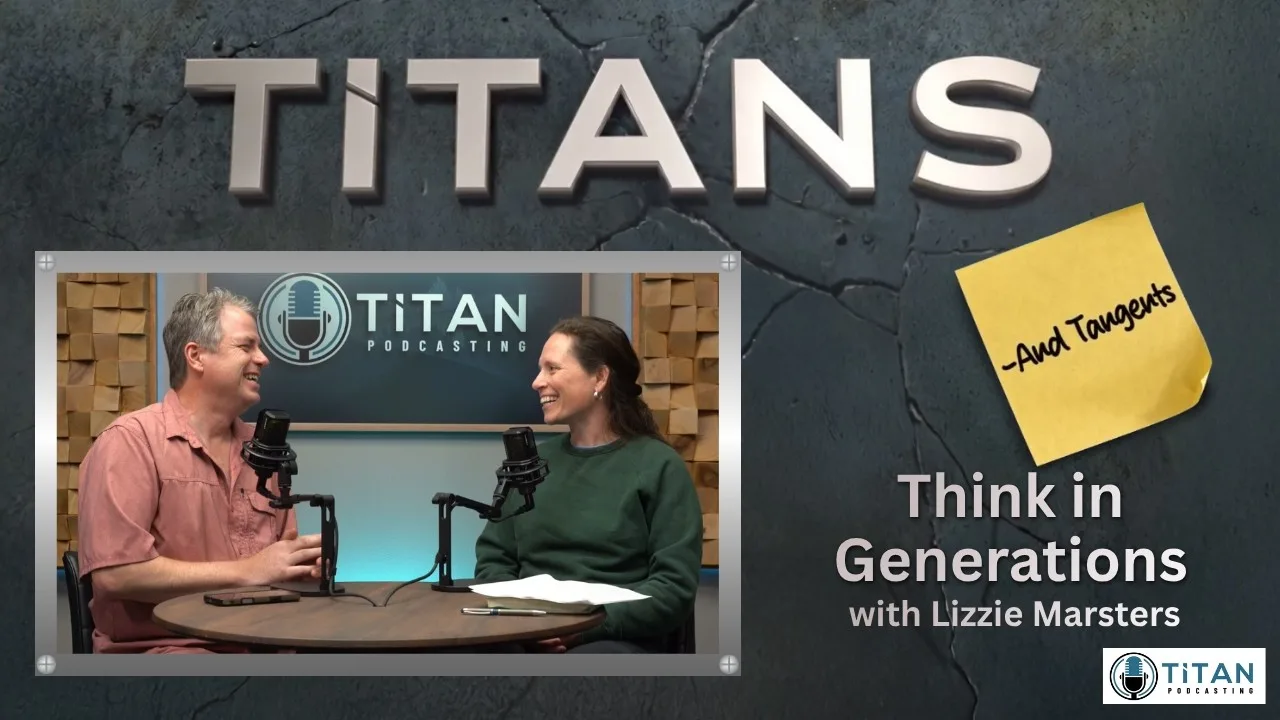
The full episode
Watch the full conversation
Playing the video connects to YouTube. Watch directly on YouTube
In this conversation
A guide to the subjects discussed.
- 01Sustainable forestry
- 02Wildfire preparation
- 03Family ownership
- 04Public recreation
Read the conversation
Full episode transcript
This transcript has completed Titan Podcasting staff review. Timestamps link to the source episode.
Read Full Transcript
- 0:00 on YouTube
Scott Kemp
Some businesses are built for the next quarter. Starker Forests has been built for the next generation. Today on Titans and Tangents, we sit down with Lizzie Marsters, CEO and president of Starker Forests, a fifth-generation family-owned forestry company rooted right here in Oregon.
Lizzie's path has taken her from federal land policy to global environmental finance to leading one of Oregon's longest-standing forestry companies into its next chapter.
And today, I promise you, you will hear forestry in a way you probably haven't heard before, not just as trees and timber, but as family, fire, water, wildlife, jobs, legacy, and decisions that can shape a community for decades. I'm your host, Scott Kemp, and this is Titans and Tangents.
- 0:41 on YouTube
Titans & Tangents theme: Titans and Tangents, step inside. Where leaders speak and heroes shine. Stories with purpose. Moments that climb. Titans and Tangents. Now it's time.
- 0:59 on YouTube
Scott
Lizzie, thanks for joining us on the podcast today.
- 1:01 on YouTube
Lizzie Marsters
Thank you so much for having me.
- 1:02 on YouTube
Scott
Yeah, this weather is going to be awesome coming up, right? Like 90-degree temperatures.
- 1:06 on YouTube
Lizzie
90 degrees, which is not awesome weather for the forest.
- 1:08 on YouTube
Scott
Yes. I can imagine that. I predict kind of a brutal fall with the amount of rainfall that we had this spring, right?
- 1:14 on YouTube
Lizzie
We're seeing hot, high temperatures with little rainfall, which means fire season for us.
- 1:21 on YouTube
Scott
Yeah. I remember a few years ago, maybe four or five now, September was just orange everywhere, all day, every day for a month.
- 1:27 on YouTube
Lizzie
And that is our worst nightmare. And so we do a lot to try and prevent that from happening.
- 1:32 on YouTube
Scott
All right. So let's back up. You are with Starker Forests, right?
- 1:35 on YouTube
Lizzie
I'm with Starker Forests.
- 1:37 on YouTube
Scott
So you're the CEO, and relatively recently hired there, right?
- 1:40 on YouTube
Lizzie
I'm very new, starting this year.
- 1:42 on YouTube
Scott
Okay. So you came to Oregon for this job, or did you grow up in Oregon? Tell me the story there.
- 1:47 on YouTube
Lizzie
I came to Oregon. I took a summer internship when I was at school at Yale doing a joint degree in forestry and business.
- 1:55 on YouTube
Scott
Yale, that's...
- 1:56 on YouTube
Lizzie
All the way from the East Coast.
- 1:57 on YouTube
Scott
Oh my gosh.
- 1:58 on YouTube
Lizzie
And where is the best place on Earth to practice business and forestry but Oregon?
- 2:03 on YouTube
Scott
The Pacific Northwest.
- 2:05 on YouTube
Lizzie
I was so lucky. I went and visited in the summertime and traveled around all of Oregon, and I was like, "This is the most beautiful place to live."
- 2:11 on YouTube
Scott
It is beautiful.
- 2:11 on YouTube
Lizzie
And I decided to move here for a job, and that first winter, that was an awakening where I was like, "Oh. Oh, boy." Oregon is not just glory and sunshine the whole year round.
- 2:24 on YouTube
Scott
There's a reason it's green, right?
- 2:25 on YouTube
Lizzie
There's a reason it's green.
- 2:26 on YouTube
Scott
It's because of the water.
- 2:27 on YouTube
Lizzie
And I'm originally from Colorado. So Colorado grows snobs in terms of weather. We love our sunshine. And you go anywhere else in the country, and you can have something to complain about. But Oregon, I've been here since 2016, so I now call it home.
- 2:43 on YouTube
Scott
So you're not brand new to Oregon.
- 2:44 on YouTube
Lizzie
Not brand new.
- 2:46 on YouTube
Scott
So what did you do before Starker Forests?
- 2:48 on YouTube
Lizzie
Before Starker Forests, I've had a really diverse career. I've been very fortunate. My whole arc of my career has been working on natural resource issues. From the federal level, as you talked about, to global, working in international climate finance, as well as the local level.
And so prior to this, most immediately, I was working at the World Resources Institute, and I had two focuses there. One was in sub-Saharan Africa. How can we harness the power of nature to provide economic activity, to provide infrastructure in places where there wasn't much, and there's not a lot of money for it?
And so really thinking creatively about how to utilize natural resources as a means to providing that for communities. And then I was also very focused in the US West on catastrophic fire, how to help communities pay for and identify catastrophic fire risk across public and private lands.
- 3:48 on YouTube
Scott
We could do an entire episode on forest fires, right? It has completely changed. I think it has. There's forestry practices that are part of it. There's government policy that's part of it. Insurance companies are pulling out of entire states because of it. What do you do with power lines when they cause fire?
It's crazy, right?
- 4:08 on YouTube
Lizzie
It's crazy. And actually, it's one of the biggest risks that Oregon businesses have identified as one of the challenges that we're going to face going into the future, not just as a forest company but the state writ large. It is a huge deal. And we see it as a big risk to our business.
We have 96,000 acres of forest that we manage.
- 4:31 on YouTube
Scott
That's a lot. Have you done the math? How many square miles is that?
- 4:34 on YouTube
Lizzie
I have not done the math in square miles.
- 4:35 on YouTube
Scott
Let's see. I think it's 640 acres. So if it was 1,000, it'd be 96 square miles, but I'm going to say around 140, 150 square miles.
- 4:47 on YouTube
Lizzie
I'll take your word for it.
- 4:48 on YouTube
Scott
That's a lot.
- 4:49 on YouTube
Lizzie
It's a lot. But it's an incredible honor and privilege to steward this land. We take great pride in how we do it. And fire is one of those things we take very seriously.
So we take on six interns each summer and we train them and send them to fire school so that we can have additional capacity to address any fire on the landscape.
- 5:10 on YouTube
Scott
Now, do you guys have trucks and all that sort of thing?
- 5:12 on YouTube
Lizzie
We just bought another firetruck, so we have three firetrucks.
- 5:16 on YouTube
Scott
I saw a firetruck on Facebook. Did you buy that one?
- 5:18 on YouTube
Lizzie
We bought that one.
- 5:19 on YouTube
Scott
You did. Oh my gosh. That's awesome.
- 5:22 on YouTube
Lizzie
We were really lucky and got the bid. This just happened last night, so fresh off the news.
- 5:28 on YouTube
Scott
Oh my gosh. I saw that firetruck. I'm like, "I want a firetruck."
- 5:32 on YouTube
Lizzie
You do want a firetruck, but with it comes great responsibility.
- 5:35 on YouTube
Scott
Oh, yeah. And they're expensive to maintain and all that.
- 5:37 on YouTube
Lizzie
They're expensive.
- 5:38 on YouTube
Scott
We just shot a big video for the Albany Fire Department, and they're paying over a million dollars now for their new rigs. That's crazy.
- 5:45 on YouTube
Lizzie
Yes.
- 5:46 on YouTube
Scott
So that was not nearly that much.
- 5:49 on YouTube
Lizzie
It was not that much. We found it at a great deal, actually. And it's going to replace a vehicle we already have.
But one of the key things for us is we want to be one of the first responders to any fire on the landscape, whether it's on our property or adjacent properties, because a fire anywhere is a threat to all of us.
- 6:08 on YouTube
Scott
That's right. Yeah. We live out south of Corvallis, and we're out of any fire district. And so unless there's life on the line, they won't come. You call 911, they're like, "Sorry. Good luck." So all the farmers band together.
They all have their pumper trucks, and there's a call tree, and you call one, everybody calls each other, and within minutes, there's five or six homemade pumper trucks. Not nearly as nice as the one you just bought, but they're pouring water on the fire.
I was there, and our neighbor's barn caught on fire, and there was four or five rigs there within minutes.
- 6:42 on YouTube
Lizzie
That is fantastic. And that's what we want to see, and we have such a strong community here in terms of other forest landowners having their own rigs as well. Thompson Timber is one of them we work a lot with. We have a great relationship with ODF.
And it's something that is both something we take great pride in, in terms of preparation and being responsive to any fire, but also huge concerns.
- 7:08 on YouTube
Scott
So now let's talk about Starker Forests and 96,000 acres. It's been in the Starker family for a long time, right? How did that start?
- 7:18 on YouTube
Lizzie
We are celebrating our 90th anniversary this year.
- 7:20 on YouTube
Scott
Did they buy 96,000 acres, or did they just have a little bit and then just keep adding on, or what did they do?
- 7:25 on YouTube
Lizzie
It's one piece at a time.
- 7:27 on YouTube
Scott
One piece at a time.
- 7:28 on YouTube
Lizzie
It started with TJ Starker in 1936. I believe April 4th was the first property he purchased. And he has been growing it with the descendants of his family. We are now in the fifth generation of Starker family members.
- 7:43 on YouTube
Scott
That's cool.
- 7:44 on YouTube
Lizzie
It is great. Only 3% of family businesses make it this far. So it is incredible to think about how you pass on this legacy to the next generation, and it's something the Starkers have done really well. And the best way we've been sort of growing is slowly and through a lot of neighborhood relations.
And so we care very much how we are as a neighbor and showing up. And so oftentimes, the way we've accumulated more acres is our neighbors say, "Hey, we're ready to sell," either through a generational shift or ready to go. "Would you be interested in buying this? You are great stewards of the land.
We respect what you do, we know what you do, and we know you."
- 8:31 on YouTube
Scott
So would you say it's kind of like a patchwork of properties? Where does it range from?
- 8:36 on YouTube
Lizzie
So 1936, TJ was buying all across the state. You had Southern Oregon, more Western Oregon, and over time, we actually consolidated to be located more towards Corvallis and the Philomath area and Newport. The reason being is we wanted our foresters to have a work-life balance.
And so the rule was, "Let's not have the foresters drive more than an hour to reach our forests."
- 9:03 on YouTube
Scott
Well, that's great.
- 9:04 on YouTube
Lizzie
Yes.
- 9:05 on YouTube
Scott
It takes me two hours just to go camping.
- 9:08 on YouTube
Lizzie
And so we've been trading parcels ever since to try and create this perfect batch.
- 9:12 on YouTube
Scott
And I saw something on YouTube recently that Southern Oregon isn't a great environment for growing Doug fir. They just need more water than it can provide down there, from what I've seen. So this kind of area is ideal for it. And that's your main crop, is that right?
- 9:29 on YouTube
Lizzie
We have a multitude of species that we plant, but Doug fir is the primary one we—
- 9:35 on YouTube
Scott
Yeah, that's what pays the bills, right?
- 9:36 on YouTube
Lizzie
That's what pays the bills. And it is native here, and it grows really well here. We are doing some assisted migration plots, which means we're examining, with the understanding that maybe climate change is going to change our weather patterns here. We'll see less water.
We'll see more of what the Southern United States is experiencing, should any of those species be better off being planted here. And so we're doing some studies on assisted migration.
Right now, we're seeing the Doug fir continuously outperforming some of the other species from our southern friends, which just gives you confirmation that this is Douglas fir home. It's native.
- 10:16 on YouTube
Scott
Yeah. I love it. So managing a forest, there is so many different things to juggle, right? You've got profit. Every company is in business to make a profit, so you want to do that. You have environmental stewardship.
Tell me about some of these other factors that you guys have to deal with, with every decision that you make.
- 10:38 on YouTube
Lizzie
Environmental stewardship is one. One is caring for the natural resource. And one of the biggest challenges is we do long-term forestry, which means we are growing a crop for 60 to 90 to 100 years.
- 10:49 on YouTube
Scott
My goodness.
- 10:50 on YouTube
Lizzie
And so the crops we're planting today, or the trees we're planting today, we will hopefully not see their outcome. That'll be for the next generation. And so it's—
- 11:00 on YouTube
Scott
That's so crazy.
- 11:00 on YouTube
Lizzie
—long-term stewardship is really what guides us and our principles more so than anything.
- 11:06 on YouTube
Scott
Because you guys could cash out immediately, right? And just take a big bundle of cash, and clear cut the whole thing and move on, right? But you're not doing that, obviously.
- 11:14 on YouTube
Lizzie
We're not doing that. And that's one of the beauties, or I think one of the places where a family-owned business really aligns well with the incentives of a forest business. Where we want to see this in perpetuity for the Starker family, which means our timeline for management is long-term.
- 11:30 on YouTube
Scott
Yeah. And I can imagine if a big company-owned forest with shareholders and publicly owned, they want a return on their investment right now. At maybe the cost of we don't really care what it's going to be in 50 years. We want a three-year return. With a family, they're looking at 50 years, 100 years out.
- 11:50 on YouTube
Lizzie
Yes, exactly.
- 11:51 on YouTube
Scott
That's very different. So it's probably we wish more forests were owned by these family-run organizations, right? Because that is the long-term outcome that we want.
- 12:01 on YouTube
Lizzie
It's a tricky question. So I would say yes, I think Oregon having many of the acres in family-owned forest land has a really great outcome. Yet we all rely on the timber products that are produced from our forests, no matter who owns that forest. And so really thinking through, how do we also have affordable housing?
So much of our wood products helps to drive this economy.
- 12:26 on YouTube
Scott
That's right.
- 12:26 on YouTube
Lizzie
Think about the packaging that goes around toilet paper.
- 12:29 on YouTube
Scott
So many things use wood.
- 12:30 on YouTube
Lizzie
So many things.
- 12:31 on YouTube
Scott
It's crazy.
- 12:32 on YouTube
Lizzie
How do we keep that affordable? And so one of the key questions is how to ensure that we have the regulations in place, and I'd say we have them in Oregon, in terms of making sure we have environmental stewardship. Regardless of who owns it, they are required to enact high standards of environmental stewardship.
We have the privilege, because we are so long term, of growing a multitude of different products off of our trees that we grow. And that is our goal. So we are going to grow for utility poles as well as sort of these larger logs that can go into different products.
- 13:06 on YouTube
Scott
Mm-hmm. What's the average size that you'll harvest a tree at?
- 13:11 on YouTube
Lizzie
So typically it's not a size diameter that we'll go for.
- 13:15 on YouTube
Scott
What are you using for your metrics to decide when to harvest?
- 13:18 on YouTube
Lizzie
Twofold, or actually it's a threefold question. One, it's very important to us for sustainable yield. So we will never harvest more than what we can grow on an annual basis. And what that actually translates to is we're harvesting less than our sustainable yield on a year-to-year basis.
The second thing that drives that is we typically don't cut larger clearcuts. In Oregon you can cut up to 120 acres. We're at a 30, 40, 50 acre clearcut. And the reason you have to do clearcuts is Douglas fir needs that full sun.
- 13:53 on YouTube
Scott
I was going to ask you that. Because people say clearcuts are ugly, or why are you clearcutting? Talk to me about that.
- 14:01 on YouTube
Lizzie
So having gone to Yale, some of my forestry experiences are in New England. There, you're really growing mature hardwoods and you're looking at your oaks. They do not need full sun to grow. And so you don't need to do a clearcut.
You may be just thinning or doing shelterwoods, which means you're taking less of the trees out of where you've harvested or a site. In Oregon, Douglas fir needs full sun to grow. We also require free to grow, so that over time the trees we cut have to reach a certain height in time.
And in order for that to happen, Douglas fir needs as much sunlight as possible, which means we need to remove trees. You want to remove as many trees as possible in order for the next generation to grow up, and you're removing some of that vegetation that can be invasive species that really compete with it.
- 14:55 on YouTube
Scott
What are you guys struggling with with invasive species? Is it Scotch broom?
- 14:59 on YouTube
Lizzie
Scotch broom's a big one. There's several out there.
- 15:06 on YouTube
Scott
Yeah. What's the worst? Pick the worst.
- 15:08 on YouTube
Lizzie
I'm so new on the job I would have to ask my foresters exactly. But for me, Scotch broom's the easiest one to identify.
- 15:14 on YouTube
Scott
You know the one I hate the most, it's probably not invasive, is poison oak. So I got a patch right here. This is almost healed. For two weeks it's been really gross. Have you had a good case of poison oak yet?
- 15:26 on YouTube
Lizzie
As soon as I moved here to Corvallis, I got a bad case of poison oak. I was running.
- 15:30 on YouTube
Scott
Oh my gosh, it's so bad.
- 15:31 on YouTube
Lizzie
And I am highly, highly allergic.
- 15:33 on YouTube
Scott
Me too.
- 15:34 on YouTube
Lizzie
And so that is the one challenge of operating in these forests.
- 15:37 on YouTube
Scott
I never used to be. I grew up in Alaska, and I don't think they really had a lot of it there, or I didn't get it. And I got to Oregon and probably for the first 20 years did not get it. And then now I'm getting it. My dog will run through a little bit of it and brush against me.
And I'll get it sometimes so bad where it'll get in my bloodstream. I think it's called systemic. And it starts popping out everywhere.
- 16:02 on YouTube
Lizzie
Everywhere.
- 16:03 on YouTube
Scott
And I mean everywhere. And it's miserable.
- 16:07 on YouTube
Lizzie
It's miserable. And then you go on steroids, which I had to do recently.
- 16:11 on YouTube
Scott
Oh, that bad?
- 16:11 on YouTube
Lizzie
It was that bad.
- 16:12 on YouTube
Scott
Oh my God.
- 16:12 on YouTube
Lizzie
But we had just moved. And the good news about steroids is you get a lot of energy, and I was like, "Great. Unpack this box. Unpack this box." It was like the perfect oomph to clear house.
- 16:23 on YouTube
Scott
Yeah. I can spot poison oak a mile away now.
- 16:26 on YouTube
Lizzie
You learn fast, huh?
- 16:27 on YouTube
Scott
Hopefully maybe we'll show a couple pictures on the screen of what it is, but leaves of three. And they don't necessarily have to look like an oak leaf, right? They can be a kind of nice and round leaf. But it's that leaves of three, and if they have thorns then it isn't poison oak.
- 16:42 on YouTube
Lizzie
That's usually, yeah.
- 16:44 on YouTube
Scott
Yeah. If it has thorns you're good. You might get poked, but you're not going to get poison oak.
- 16:46 on YouTube
Lizzie
You're not going to get poison oak. And my challenge in the winter is that it's harder to identify sometimes. And it can be a vine, it can be on the ground. So you really got to be watchful.
- 16:55 on YouTube
Scott
Yep. And I've heard horror stories of people burning it, and then they get it in the smoke, and the oil goes in the smoke, and then they get poison oak in their lungs.
- 17:04 on YouTube
Lizzie
Lungs. Ugh. Yeah.
- 17:05 on YouTube
Scott
I think at some point you were in the hospital at that point.
- 17:07 on YouTube
Lizzie
I think so too. Yeah.
- 17:08 on YouTube
Scott
Oh my gosh. One of the things living in Oregon for, boy, now almost 40 years is I have been able to enjoy Starker Forests. It's really cool that you guys, you're not running people down like, "Get off my land, get off my land." Tell me a little bit more about that.
- 17:24 on YouTube
Lizzie
So we have a free permit system. And we invite hunters, bikers, hikers, horseback riders to come and recreate on our lands. But we want to know who you are. Because it's a community-building relationship. We want to share this community asset.
We believe that the more people are on our property, we have more eyes in terms of helping us to identify fires or any issues on the landscape. In addition, it's a great opportunity for us to invite you in and understand what we're doing in terms of forest operations.
I think one of the biggest challenges to running a forest operation today in Oregon and in this country is the disconnect between urban and rural users. And can we get more urban folks and those who enjoy getting outside to understand what we're doing in the forest?
- 18:15 on YouTube
Scott
Right.
- 18:16 on YouTube
Lizzie
And to understand what our practices are, as opposed to this disconnect.
- 18:22 on YouTube
Scott
Yeah, because for better or for worse, Oregon, its population is urban.
- 18:28 on YouTube
Lizzie
It's urban.
- 18:28 on YouTube
Scott
And that majority is the ones that make the laws. And unfortunately, some of the rural people, the Eastern Oregon, the Central Oregon, we're kind of at the mercy of voters in Portland and Salem and Eugene. So the more we can get those people to understand this way of life and here's what happens.
We are making building products so you can have houses and have toilet paper and all these other things. I think that's a good thing, right?
- 18:53 on YouTube
Lizzie
I think it's a great thing. The other piece of it is we just want to be transparent. Here's what we're doing. Come check out and see what we're doing. We believe very strongly in our stewardship practices, and we want to show you and talk to you about it.
And if you have questions, that's a great opportunity for us to engage and really talk about what are the challenges in terms of growing trees. And we're seeing increasing regulation, to your point, that makes it more and more challenging for us to manage long-term forest operations.
And the key thing for me, from all my experience in federal land management to private land management, how do we increase our adaptability and our nimbleness to respond to either environmental events or new research? And to be those environmental stewards as we find out more and more about the forest that we grow.
And with regulation, that makes it challenging to be nimble.
- 19:50 on YouTube
Scott
Can people just call you guys up and talk to you about this, or will you take appointments or phone calls or what? How can they contact you? How do they know more about it?
- 20:00 on YouTube
Lizzie
There's a couple of ways. One, yes, we would love to chat to people about our practices and invite you to come on the land. We actually host public tours.
We go into K through 12 schools and want to take kids out, both to give them the exposure that if you want to work in natural resources, there's so many jobs out there, come and see what they look like. But also to educate—
- 20:27 on YouTube
Scott
How many people are you guys employing?
- 20:29 on YouTube
Lizzie
So we are foresters, and we grow trees. And so at Starker Forests, we have about 20 employees right now. We employ, through contractors with loggers and planters, about 100 people. And—
- 20:47 on YouTube
Scott
That's a big deal.
- 20:48 on YouTube
Lizzie
It's a big deal. And the other piece of it is we're so tied to our contractors. We would not be successful without them. So how do we create a stronger community and workforce both for our loggers, but us as well, and then also for our end products?
We need mills and manufacturing facilities to help us get a tree into somebody's home in a manufactured way.
- 21:11 on YouTube
Scott
So do you guys contract out the actual harvesting and the cutting and all that, or do you do that in-house?
- 21:16 on YouTube
Lizzie
We do not do any of that in-house. So that is—
- 21:17 on YouTube
Scott
You're really just kind of the management of it.
- 21:20 on YouTube
Lizzie
We grow the trees. And then we contract out—
- 21:24 on YouTube
Scott
Sounds like you're growing jobs, too.
- 21:25 on YouTube
Lizzie
We're growing jobs, too. We grow the trees, and we grow jobs. And one of the things that's so important to us, and probably a unique thing in the forest industry, is that we care so much about our contractors. We want to give them the security and year-round jobs.
And so we will try to ensure that we have places to operate that protects both the land but offers opportunities for job security for our contractors. And so that's something that's very important to us through good times and bad. How do we employ our loggers with consistency and giving them the security that they need?
- 22:00 on YouTube
Scott
Yeah. I grew up in Ketchikan, Alaska, in the Tongass National Forest, and I had a lot of friends who were loggers and in that industry. And I can attest to how hard those people work, how early they get up in the morning. Just hardworking people, and it's a very dangerous job.
I don't think there is very many classifications that pay a higher workers' comp rate than timber cutters do.
- 22:26 on YouTube
Lizzie
Yeah. It is a very dangerous job, and it's one that we're not seeing a ton of new entrants into that field. And so it's something we really want to pride ourselves on in terms of taking care of the contractors that are there. And they do an incredible job.
We have really high-quality local contractors who are generational.
- 22:46 on YouTube
Scott
That's awesome.
- 22:46 on YouTube
Lizzie
Many of them—
- 22:46 on YouTube
Scott
Yeah, that's right.
- 22:46 on YouTube
Lizzie
—have been working for us for years, and going back to their fathers' fathers. And so Starker has a strong relationship. Many of these companies are family companies all the way through, and we're so reliant on each other.
- 22:59 on YouTube
Scott
That's cool.
- 23:00 on YouTube
Lizzie
One of the things, though, that I do want to talk about is the Starker ethos in terms of how do we care for our people and our contractors and address some of the workforce challenges we see in the future. We just recently opened up a daycare.
- 23:15 on YouTube
Scott
A daycare?
- 23:15 on YouTube
Lizzie
A daycare.
- 23:16 on YouTube
Scott
Starker Forests Daycare.
- 23:17 on YouTube
Lizzie
Starker Forests Daycare. It's called Betty's House. And it's after Elizabeth Starker, who was the grandmother of the fourth-generation owners right now. And she really cared for the staff, would always bake cookies, and we have taken her house, which is on the property, and converted it to a 12-kid childcare center.
And this is in partnership with Old Mill, who's an incredible nonprofit.
- 23:42 on YouTube
Scott
Okay, yeah. I know them.
- 23:43 on YouTube
Lizzie
And the goal here, we realized, is that it's really hard to work our forestry hours or our contractor hours, which the day starts at 6:00 a. m.
- 23:51 on YouTube
Scott
That's right.
- 23:52 on YouTube
Lizzie
And so our daycare is opening at 6:30 to 4:00 in order to help any of our family, contractors, and our staff bring their kids to work, so to speak, for me, and create a better work-life balance and create something that is a family.
- 24:09 on YouTube
Scott
I love it. That is totally unique. Raul, we need a Titan Podcast daycare.
- 24:15 on YouTube
Lizzie
We want to see more companies do this. How do you take care of your employees? How do you make it easier to have a family and go to work?
- 24:23 on YouTube
Scott
What I haven't heard yet is how do we make the most money possible. You guys are like, "How do we make this last for our children? How are we taking care of families, work-life balance?" That's really cool.
- 24:36 on YouTube
Lizzie
One of the reasons I'm so excited to be at Starker Forests is there's a true belief in the triple bottom line. We need to make money. But making money allows us to give back to the community that gives us so much, and it also allows us to give back to our employees.
And so we really think hard about what our environmental stewardship is, what's our social responsibility, and how can we make a really sustainable, longstanding business for the economics.
- 25:05 on YouTube
Scott
I love that. I love that. It's cool. CEO, that's a neat position. You probably had to fight for that, and not just anyone walks in there and becomes a CEO, so congratulations.
- 25:16 on YouTube
Lizzie
Thanks.
- 25:17 on YouTube
Scott
I own a couple businesses, but anybody could own a business. You can have a lemonade stand, that's a business, and be a business owner, but to be a CEO of a big company, that's pretty cool. Congratulations.
- 25:27 on YouTube
Lizzie
Thank you. It's a great honor.
- 25:29 on YouTube
Scott
So what do you do when you're not working? What are your hobbies? What do you like to do?
- 25:34 on YouTube
Lizzie
So this weekend, actually, there is a race, a trail race on Starker Lands. And I love going trail running. It is my mental release and relaxation. I have two kids at home. I used to be able to say two months ago, two under two, but they're—
- 25:53 on YouTube
Scott
Okay. Wow, that's young still.
- 25:54 on YouTube
Lizzie
—two years old and nine months.
- 25:56 on YouTube
Scott
Oh, my gosh.
- 25:56 on YouTube
Lizzie
My husband and I, whenever we need just to let off a little bit of steam, we go out for a run, and we go out into the woods.
- 26:02 on YouTube
Scott
Leave the kids at home, right?
- 26:03 on YouTube
Lizzie
Leave the kids at home. The other one takes care of them. And it's our way—
- 26:07 on YouTube
Scott
Wait, the two-year-old takes care of the nine-month-old?
- 26:08 on YouTube
Lizzie
Yeah, exactly. We started it early here. They learn that at daycare.
- 26:14 on YouTube
Scott
I love that.
- 26:15 on YouTube
Lizzie
Yeah. But yeah, that's what I love to go do. I love being with friends. And one of the biggest challenges moving to Corvallis is building a new community. But it's also one of the most exciting things to do is getting to meet new people. And so that's something I'm working on right now.
- 26:33 on YouTube
Scott
Love it. Thanks for coming on. We got a little bit of a game here we're going to do. And I'm going to do a Would You Rather, Forestry Edition, okay? Don't look at the questions in advance. So are you ready?
- 26:45 on YouTube
Lizzie
Yes.
- 26:45 on YouTube
Scott
Would you rather manage a forest with perfect trees but difficult neighbors, or a forest with difficult trees but great neighbors?
- 26:52 on YouTube
Lizzie
Ooh. Social license is huge, so great neighbors.
- 26:58 on YouTube
Scott
Great neighbors. Wow, so you'd go for the difficult trees. Okay, would you rather explain forestry to a room full of kindergartners or a room full of angry adults at town hall?
- 27:07 on YouTube
Lizzie
Oh, easy. Kindergartners.
- 27:09 on YouTube
Scott
I kind of knew where that one was going. Would you rather have perfect weather all year but terrible road access, or great road access but unpredictable weather?
- 27:18 on YouTube
Lizzie
Unpredictable weather.
- 27:19 on YouTube
Scott
Really? So tell me about that. The roads are important for you.
- 27:22 on YouTube
Lizzie
Roads are important for us. Unpredictable weather, we can manage that. We're currently facing it every year.
- 27:30 on YouTube
Scott
That's right.
- 27:30 on YouTube
Lizzie
Wind storms, snow storms.
- 27:31 on YouTube
Scott
That's right.
- 27:32 on YouTube
Lizzie
And there's things you can learn about that.
- 27:35 on YouTube
Scott
Okay, would you rather be known for a company with the best timber or a company with the best community relationships? I think I know the answer where this is going.
- 27:44 on YouTube
Lizzie
Well, actually, we have both, so that one, I don't think—
- 27:46 on YouTube
Scott
No, you've got to pick one.
- 27:47 on YouTube
Lizzie
I have to pick one?
- 27:47 on YouTube
Scott
You got to pick one.
- 27:49 on YouTube
Lizzie
Community relations.
- 27:51 on YouTube
Scott
But then you might not have a job later, though.
- 27:54 on YouTube
Lizzie
I might not have a job, so timber? Yeah. Thank God that's not a choice we actually have to make.
- 28:00 on YouTube
Scott
Would you rather spend a day planting trees, walking a harvest site, checking recreational access, or talking with students about forestry?
- 28:08 on YouTube
Lizzie
Ooh, I personally might enjoy the talking to students, but I also would love to— It is so cool to go out and see operations. So, one of two things.
- 28:16 on YouTube
Scott
I love that. I love people working with their hands and seeing that.
- 28:20 on YouTube
Lizzie
It is amazing work that they do out there.
- 28:23 on YouTube
Scott
Yeah, it is so cool. Would you rather solve wildfire risk or public misunderstanding about forestry?
- 28:32 on YouTube
Lizzie
Public misunderstanding.
- 28:33 on YouTube
Scott
Okay, I like that. Would you rather have your company be described as innovative, trustworthy, resilient, or responsible?
- 28:43 on YouTube
Lizzie
Trustworthy.
- 28:44 on YouTube
Scott
Trustworthy, I like that. Because if you have trustworthy, you kind of have everything else, right?
- 28:48 on YouTube
Lizzie
You are responsible. You should be innovating.
- 28:50 on YouTube
Scott
Yeah, that's right. Would you rather make a decision that pays off quickly but only for a few years, or take 20 years to pay off but helps the next generation?
- 28:58 on YouTube
Lizzie
Easy. 20 years.
- 29:00 on YouTube
Scott
Yeah, I love that. So that's why they hired you, right? Would you rather every Oregonian understand how forestries are managed, where wood products come from, or what private forest lands contribute to communities?
- 29:12 on YouTube
Lizzie
That one's a selfish one. How forests are managed.
- 29:14 on YouTube
Scott
Yes.
- 29:16 on YouTube
Lizzie
But we need them all.
- 29:17 on YouTube
Scott
Again, I think people's exposure to it is like, "Oh, there's a clear cut. It's ugly clear cut." But there's so much more to it than that.
- 29:24 on YouTube
Lizzie
There's so much more complexity. And if you look at the disturbances that are happening, you asked about unpredictable weather. If you look at those disturbances, we are, to our best ability, managing some of our clear cuts like a disturbance. And so we are trying to mimic what nature does naturally.
- 29:42 on YouTube
Scott
Yeah. Nature takes care of itself a lot with forest fires, right? That's like a whole other episode. Do you let them burn? Do you not let them burn? We're not even going to go there.
- 29:50 on YouTube
Lizzie
We're not even going there.
- 29:53 on YouTube
Scott
All right. Do we have another question? Okay, would you rather have a forest that is easier to manage or more interesting to manage?
- 30:02 on YouTube
Lizzie
More interesting.
- 30:03 on YouTube
Scott
Yeah, because things are interesting, right?
- 30:05 on YouTube
Lizzie
Well, all of them are interesting. Each are so site-specific. We have a lot to learn from them.
- 30:11 on YouTube
Scott
Yeah. Well, thanks for coming on today, Lizzie. This was awesome. Learned more about Starker Forests. That's pretty cool. So that does it for this episode of Titans and Tangents. Big thanks for our guest for sitting down with us and sharing the story behind the work.
So we created this show to highlight the titans in our community, people doing meaningful work, building real businesses, and leading in their own lane. And that's what Titan Podcasting helps businesses do, too. In crowded fields, it's not enough just to say you're good at what you do.
A podcast lets people hear how you think, what you know, and why people should trust you. And Titan Podcasting helps turn those conversations into polished content that positions your business as a subject matter expert. I'm Scott Kemp. Thanks for listening. Thanks, Lizzie. I kind of mixed the two together there.
And we'll see you next time on Titans and Tangents.
- 31:00 on YouTube
Music: [upbeat music]
Your next recording