
Full conversation
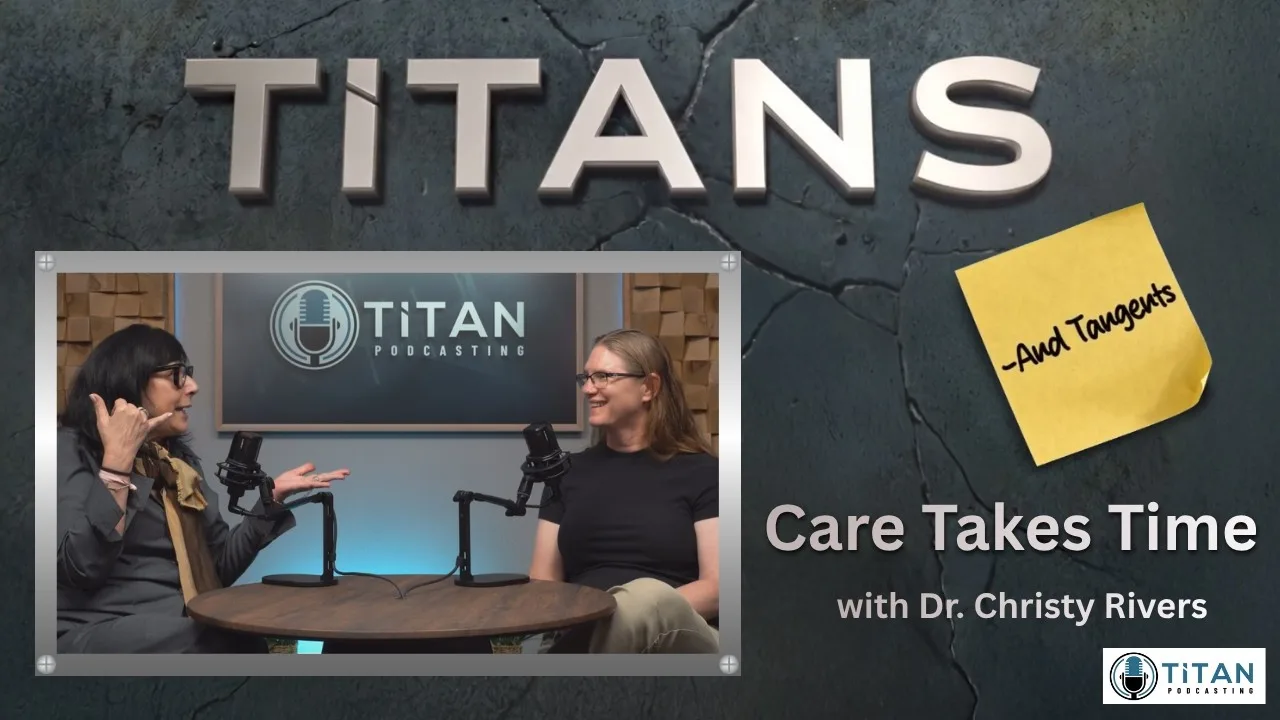
Care Takes Time
with Dr. Christy Rivers
Dr. Christy Rivers and Marki Costello discuss direct primary care, pediatric home visits, trust with families, mental health, screen time, and what changes when a doctor has time to listen.
The full episode
Watch the full conversation
Playing the video connects to YouTube. Watch directly on YouTube
In this conversation
A guide to the subjects discussed.
- 01Direct primary care
- 02Pediatric home visits
- 03Family trust
- 04Mental health and screen time
Read the conversation
Full episode transcript
This transcript has completed Titan Podcasting staff review. Timestamps link to the source episode.
Read Full Transcript
- 0:00 on YouTube
Titans & Tangents theme: Titans and Tangents, step inside. Where leaders speak and heroes shine. Stories with purpose. Moments that climb. Titans and Tangents. Now it's time.
- 0:18 on YouTube
Marki Costello
Welcome to Titans and Tangents, where big ideas collide with real life, and the conversation can pivot from pediatric medicine to parenting chaos faster than a toddler with a permanent marker. Today's guest is redefining what healthcare can look like for modern families.
Joining us is Dr. Christy Rivers, founder of New Way Pediatrics in Corvallis, a concierge pediatric practice built around a simple but revolutionary idea, families deserve more time, more access, and more personalized care. Amen.
Dr. Rivers has served as a US Naval medical officer and spent years caring for children and supporting parents through every stage of growing up, from sleepless newborn nights to the emotional rollercoaster of teen years, which we just talked about.
What makes her approach stand out is her belief that medicine should feel re—
- 1:12 on YouTube
Dr. Christy Rivers
Relational?
- 1:13 on YouTube
Marki
Relational. Thank God I had the doctor here to help me pronounce that. Not rushed, and that's so true.
Today, we're talking about concierge healthcare, the changing realities facing parents and kids, mental health, screen time, burnout, and why sometimes the best medicine is finally having a doctor who actually has time to listen.
So, settle in, silence the group chat for an hour, and prepare for a conversation filled with insight, honesty, and probably a few stories every parent will recognize immediately. Christy Rivers, welcome to the pod.
- 1:47 on YouTube
Dr. Rivers
Thank you.
- 1:47 on YouTube
Marki
And you are a titan in your industry, and I love that you're a disruptor, meaning you were a doctor in a practice here for 10 years, 12?
- 1:49 on YouTube
Dr. Rivers
Thank you. Yes.
- 1:57 on YouTube
Marki
Yeah. And you saw that there was a problem, if you will, like, hey, there's needs that aren't getting met. And we were just discussing off-camera, as someone who moved here a couple years ago, finding doctors here for adults or kids—
- 2:11 on YouTube
Dr. Rivers
Impossible.
- 2:12 on YouTube
Marki
It's impossible. You have a better chance of winning the Oregon lottery than getting a doctor. It's frightening. So, I love this concierge medicine. I used it in LA with myself. I can't find any adult concierge yet, but you have—
- 2:32 on YouTube
Dr. Rivers
There's none in Corvallis—
- 2:33 on YouTube
Marki
None in Corvallis—
- 2:34 on YouTube
Dr. Rivers
—but I can give you some people in Eugene.
- 2:36 on YouTube
Marki
Okay. I love that. But I found you because I was trying to find a pediatrician for Finn, my 16-year-old, and once again, you get that, "Not taking on a new patient. Nope, nope." And so, I just got tired of it, and then I met you here at that group event.
And then I had you come out and you gave Finn a physical, and you gave him his first, we won't say what, shot on air. Then he immediately got sick, because Finn is also— I love my son to death.
He's literally one of my favorite people in the world, but he is the type that he will be like, "I have a headache," and, "I went on TikTok," and he goes down the rabbit hole and he's like, "I think it's a brain aneurysm. I think I have brain cancer. I think I'm dying."
- 3:06 on YouTube
Dr. Rivers
Thanks.
- 3:07 on YouTube
Marki
And I'll be like, "Finn, you have allergies and it's a head cold."
- 3:21 on YouTube
Dr. Rivers
Yes.
- 3:23 on YouTube
Marki
But it's so funny with Finn — when I'm sick, I'll say to him, "Well, honey, I hope it's nothing. I feel this or that," or he'll be like, "You're fine, Mom."
- 3:32 on YouTube
Dr. Rivers
Yes.
- 3:32 on YouTube
Marki
Yeah, because he doesn't ever want to thank Mom. So, let's talk about concierge. For people that are listening or watching or that are like, "I don't understand. What does this mean?" Break it down for them.
- 3:41 on YouTube
Dr. Rivers
So, you're using the word concierge, which I think is fine, because that's what people kind of relate to and think of, which means just exceptional service. I use the words direct primary care, because that means you're working directly with me.
A lot of times, historically, concierge medicine means you pay a huge retainer just to have access to a doctor, and then you still use your insurance.
Direct primary care, you pay a much more affordable amount to your doctor each month, and then all of your primary care services are included, so there's no surprise bills. My practice specifically is a home visit-based practice, so I don't have a brick-and-mortar building. I go to people, or we do it telemed.
And the whole goal is to have good relationships with people, and then provide care that makes sense to them.
- 4:33 on YouTube
Marki
And I'm going to say this because I've used you for my 16-year-old. You are impeccable. You come to the house. You have everything and anything anybody would need. Any question, you spend the time. Because I feel like where we are in medicine, too, like I said, I got into a doctor yesterday for myself.
You feel rushed when you actually are in front of the doctor, because you're like, "They're so busy, and they could barely squeeze me in, so here's my eight seconds of my questions I have. Like, oh," like, you know what I mean?
And then they end up leaving anyways, because she said, "I'm going to Juneau, Alaska, and I'm out." So, I was like, "Okay, great. Sure." But what I love about your service and just who you are as a human and a doctor is that no question is too big, no question is too small. Here's the timeline. You sit down.
You explain things. You're available by text or phone call, and it's just so refreshing. It's one of the reasons I took Finn off my insurance because I found you, in the sense where I was like, "Okay, cool. I know that I have her, so God forbid if he had a cold," right?
But I don't think people are realizing this has got to be the future. Or is it the future? Are we 100% there? Where are we?
- 5:44 on YouTube
Dr. Rivers
Well, we're not there now, because of a lot of reasons. People are very tied to their insurance, which I understand. And insurance does not pay for direct primary care. So, we do not work with insurance, because it kind of gets in the way of that relationship between the doctor and the patient, and makes a lot of rules.
So I think of insurance as important for when there's a catastrophe. So, you do not want to go bankrupt because of a car accident or something. But insurance is no longer... When you're paying, some people are paying thousands of dollars a month for insurance.
- 6:21 on YouTube
Marki
1,800, I've been paying.
- 6:23 on YouTube
Dr. Rivers
For you and your son. That's it, for two people. And then often—
- 6:27 on YouTube
Marki
Nothing's covered—
- 6:28 on YouTube
Dr. Rivers
—nothing's covered. And so every time you go in, you have a co-pay that might be $250. It's not a co-pay, it's your high deductible plan. And so I think that we're getting there. I'm starting to have more people joining because they can't afford insurance.
- 6:45 on YouTube
Marki
No, it's ridiculous.
- 6:46 on YouTube
Dr. Rivers
Which makes me sad because I feel like healthcare should be a right. I feel like we're paying so much money into our system that you should be able to get the care you need, but that's not true.
- 6:59 on YouTube
Marki
Well, I want to ask you a question, and maybe I just do not comprehend it. Why is healthcare so expensive? Why do other countries have universal healthcare? Why does our healthcare, year after year, just get worse and worse and worse?
- 7:14 on YouTube
Dr. Rivers
Well, I think because of the insurance in between. So insurances are for profit. And so they want to make a profit. So I do think that they are trying to have good health outcomes, but they are doing it based on statistics.
And so if statistically, this is the way that you should do medicine for a certain rotator cuff, I'm not an expert at rotator cuffs. But just these are the steps to go through before you would get to the surgery, which is the thing that would cost the most money, and then the rehab or whatever.
And so there's all these steps to go through, and if we're going to make sure there's steps, then we need to pay for people to make sure the steps are followed. So we just have this huge amount of bureaucracy involved to actually prevent healthcare from happening. And I think it starts from a good place.
I think we want to do evidence-based medicine, and so a lot of times in older days, people would do anecdotal medicine. So, "Hey, I've had a patient that this works great for, so now I'm going to do rotator cuff surgery on everybody."
Or, "I make more money as a doctor if I do the surgery, so I'm going to do it on everybody." And we don't want that. But this other extreme of not being able to provide great care for each individual patient because we're padding the insurance company system. And I think it's multifactorial. That's very simplified.
- 8:42 on YouTube
Marki
But it's interesting because I was talking to my girlfriend whose father's a billionaire, and she was saying, "Yeah, my daddy doesn't believe in insurance. He thinks it's the biggest scam in the world." Now, what's interesting is I had a lot of friends lose their houses in the Palisades.
The house where I raised my kids burned down, too. A lot of them had State Farm, and State Farm is really not paying out. They're like, "Hey, well, we're going to pay you 70%." And they're like, "Well, I didn't pay you 70% of my premium."
And the state of California's actually going to take it to the next step with State Farm to say, "We're not going to let you write policies anymore in the state," because it's been such a catastrophe.
And the state of Nebraska's, too, where people went through tornadoes, and they'd send out an adjuster from State Farm, and State Farm would be like, "Roof looks fine to me," and the guy's like, "There's a hole." Meaning, "Looks good to us."
- 9:36 on YouTube
Dr. Rivers
If you look at it that way, the roof looks great.
- 9:37 on YouTube
Marki
If you look that way, it looks great—
- 9:38 on YouTube
Dr. Rivers
Right. It feels the same—
- 9:38 on YouTube
Marki
—but you look this way, there's a gaping hole. And so the attorney general for the state said, "Yeah, we're going to sue them collectively." Now, then you see reports like that three years ago, they made $6 billion.
So you're just like, and I'm with State Farm, so I say this from a place of I pay $3,000 a year just for my son to drive. And then she told me, "Oh, and it's going to go up." And I go, "But why? He doesn't have a ticket. He didn't get in an accident. I don't have a ticket in 30 years. I don't have an acc..."
"Well, because of the fires and all the damage." "Oh, so we have to pay because you can't?" Meaning, maybe insurance on some levels is, just like you said, big business, and it just doesn't work. Same thing with insurance.
With the car insurance, with the homeowners, and I even said to her, "Well, then I'll get rid of my homeowners."
Meaning, at the end of the day, if I'm going to have to fight to get a tree that falls on my property that you had to pay for, I guess the money I save, I can just pay for someone to hack off the tree because I'm not paying for the... You know what I mean? Do you think we'll get to that point collectively?
- 10:54 on YouTube
Dr. Rivers
I do not know. I'm not an expert at insurance in general. But it does seem as if the profits are becoming more important than the people behind them.
- 11:07 on YouTube
Marki
And I think it's because, whether you love Trump or hate Trump, the bottom line is he's a president that's made a lot of profit. He's made over $6 billion as of yesterday, just him alone, not his kids, from profiting off of being the president of the free world. So maybe it stinks from the head down.
Maybe we're seeing this and we're just like, "Okay, well, if he can do it or this can happen." I always feel like the pendulum, we've lived through a pandemic. Now we have this other hantavirus in, what is it called, where you get it from rodents—
- 11:44 on YouTube
Dr. Rivers
Yes. In Argentina.
- 11:46 on YouTube
Marki
Is that going to become a full-blown pandemic—
- 11:48 on YouTube
Dr. Rivers
No—
- 11:48 on YouTube
Marki
—like COVID? Why?
- 11:49 on YouTube
Dr. Rivers
Because it does not transmit the same way. So this specific strain of hantavirus is the only one that transmits person to person, but very rarely does it. So it's endemic, meaning it lives in Argentina, and they have about 29 cases a year. So it's not spreading the way that COVID did, which was a novel new virus.
- 12:13 on YouTube
Marki
But isn't it weird to think about, in my lifetime, I've lived through two viruses. I mean, in that sense, our kids, they had to live through COVID. I worry about this next generation, with the planet.
I've been really trying to do little things, like, if we see an unhoused person with a dog, I'm like, "Well, why don't we carry dog food in Ziploc baggies and give it to the dog?" Why don't we do these little things to make the world a better place?
- 12:42 on YouTube
Dr. Rivers
A little happier place.
- 12:44 on YouTube
Marki
A little happier place. I was at Market of Choice the other day, and there was this unhoused man, and he had a sign, "Very hungry." And I was in Market of Choice, so I said, "I'm going to get him a turkey sandwich." Get him the turkey sandwich, putting my groceries in my car.
I walk over with a water and a turkey sandwich, because I said, "I could solve that problem." That's one little problem that I could solve today. And in the big slew of 80 million other ones, that's one I can solve. So I walk up to him, I'm like, "Hey, I got you a turkey sandwich."
And he looks at me, cocks his head, and he goes, "Well, I'd really rather have five or 10 bucks." And I said, "Well, you know what I would really rather have? You put something honest on that sign.
Even if it is, 'I'm going to start to get the shakes if I don't get a fifth of vodka by 4:00 PM,' because I'd probably give you the five bucks for that honesty."
- 13:32 on YouTube
Dr. Rivers
For honesty.
- 13:33 on YouTube
Marki
You know what I mean?
- 13:36 on YouTube
Dr. Rivers
I have bought food for people before who are very thankful.
- 13:42 on YouTube
Marki
Right. That gives me hope.
- 13:43 on YouTube
Dr. Rivers
I don't want people to stop getting food for people.
- 13:46 on YouTube
Marki
Right. That gives me hope.
- 13:47 on YouTube
Dr. Rivers
Yes.
- 13:47 on YouTube
Marki
That gives me hope. I don't think anybody should go hungry.
- 13:50 on YouTube
Dr. Rivers
No.
- 13:52 on YouTube
Marki
I just had a realtor, we were talking on another podcast today, and we were talking about affordable housing, and people should be able to... But you live in a college town, like where we are, and because once again, it's profits over people.
Landlords know, "No, when the kids all come to go to college, we can raise these rents to X amount," and... But then it's also hard to evict somebody, a lawyer was telling me recently, because they don't want unhoused.
So if you're a landlord, and you have three places that you're renting out at a reasonable price and not gouging, well, guess what? If that person decides, "I'm never leaving," they don't have to leave. It's really hard.
- 14:31 on YouTube
Dr. Rivers
I have heard it's really hard. Yeah.
- 14:31 on YouTube
Marki
So I don't know what the answer is. I feel like this is where we are in the world. And so I love what you're doing because I feel like you're chipping it away at a horrible problem. You're chipping it away at a good thing. You're solving that problem.
- 14:46 on YouTube
Dr. Rivers
Yeah. That's what I hope for. I think that there are... Well, we know that there are doctors leaving healthcare because it's not super fun to practice in the fee-for-service world, for many people. I'm so thankful for the doctors that are still doing it. We need that. In no way am I negative about that.
But rather than leaving healthcare, I love being a pediatrician. I want to take care of kids. How you said you felt so hurried yesterday — last week, generally my well visits now take about an hour. And I just think, how did I used to do this?
I don't know that I'm providing necessarily better care than I did before when I had 20-minute visits, but I think we're all just more satisfied. Some of the time is just taking everything out of the bag and setting up vaccines and all that stuff that other people did for me.
But a lot of it is just taking the time to listen to those other things. I've read books with kids at the house. I've had kids show me their karate moves. It's fun.
- 15:52 on YouTube
Marki
I think it's about being seen and heard. I think we are living in a time where we just want to be seen and heard. We want to know that we matter, that it counts.
- 16:02 on YouTube
Dr. Rivers
Because we do matter.
- 16:02 on YouTube
Marki
Because we do matter.
- 16:03 on YouTube
Dr. Rivers
Yeah. I mean—
- 16:04 on YouTube
Marki
I told you off-camera today, but I'll just say this little bit, when I was shouted at to get off a field for my son, it was like, "Wait, I don't matter?" That's the part that it really...
Because I'm never at a loss for words, where I was like, I didn't know how to react because it's sort of like someone seeing right through you, and what you're saying doesn't matter, when it really does.
- 16:27 on YouTube
Dr. Rivers
Right.
- 16:28 on YouTube
Marki
So I think what you provide in a time where healthcare is cuckoo bananas and really not in a great place, you're seeing the people. You're hearing them, their concerns.
Or even when my kid was like, "Oh, I need to get this vaccine," or this or that, and wanted to talk to you about it, and didn't feel rushed, or hurried, or a number. A girlfriend of mine was telling me she does telehealth to get HRT, hormone replacement therapy.
And she said that the woman who she sees over the screen was saying, "Oh, I want you to go get your testosterone tested because we want to put you on that, too." And she was like, "Why?" Long story short, she goes to get the labs, and the labs wanted some ridiculous amount of money.
So she tells the telehealth person the next time, like, "No, that's ridiculous. The three things that you ordered are the most expensive labs in the world." She was like, "No, I'm not going to do it." She ends up going to her gynecologist two months later, and the gynecologist says, "You should not be on it.
You don't need to be on it." And the gynecologist later told her, "Oh, that company then sells that lotion with the testosterone. You're buying it from them, so once again, it's—
- 17:46 on YouTube
Dr. Rivers
For profit—
- 17:46 on YouTube
Marki
—profit." Then we just get into a place—
- 17:51 on YouTube
Dr. Rivers
Lack of trust—
- 17:51 on YouTube
Marki
—we don't trust any... Lack of trust. I feel like that's where... And another example, I took Finn's car in yesterday to get the oil changed. I said to them, "Look, guys, I have taken this car in. We always get the oil changed, rotate the tires. Don't call me and tell me there's 80 million things wrong with it."
Sure enough, they call me 45 minutes later. I swear to God, like clockwork. And he goes, "Yeah, we see a leak, but we don't know where it's coming from." And I go, "Well, last time I took it in to you three months ago, you told me there was a leak, and I paid $1,200. I'm not going to fall for that again.
Just change the oil. Oh, we can't rotate the tires because the back tires, they're too bald. Just got new tires three years ago, and we rotate them every 4,000, 5,000 miles." But once again, it got me thinking, like, I know the car industry's hurting. So are they just telling me that because they need the money?
We're lacking trust—
- 18:43 on YouTube
Dr. Rivers
Everywhere—
- 18:43 on YouTube
Marki
—everywhere.
- 18:44 on YouTube
Dr. Rivers
I think that's one thing. So, for my practice to grow, people need to... So they pay a membership fee, and each month it's the same amount. But I keep having people think it's too good to be true. Like—
- 18:59 on YouTube
Marki
I think you're going to move any minute now.
- 19:01 on YouTube
Dr. Rivers
No. That—
- 19:01 on YouTube
Marki
And she's going to move, it's going to be—
- 19:02 on YouTube
Dr. Rivers
No—
- 19:03 on YouTube
Marki
—not here anymore.
- 19:03 on YouTube
Dr. Rivers
I'm not planning on moving anytime soon.
- 19:06 on YouTube
Marki
Good.
- 19:06 on YouTube
Dr. Rivers
So no promises, but I have kids going off to college. There's no reason to move, at least until they're done. But I forgot what I was going to say.
- 19:18 on YouTube
Marki
We were talking about trust, just trust in general.
- 19:19 on YouTube
Dr. Rivers
Oh. Yeah, so I think people... Like, I went to someone's house to do a visit, and they weren't quite a member. They wanted a one-time visit for a sickness. And then they're like, "But we really do want you to be a member, but we're just wondering how much will it cost for each of these one-time visits?"
And I was like, "That's included."
- 19:36 on YouTube
Marki
Right.
- 19:37 on YouTube
Dr. Rivers
"It will cost the same." And it's $150. So just to be clear, that's what we're talking about, not thousands of dollars. So for your child, $150 a month. And if you need to call me to come see his ear three times this week, hopefully...
Actually, I give people a camera so they can send me pictures of the ear, and then maybe I don't need to go all the times. But if I do, there's not an extra charge. But I think we're so used to people taking advantage of us now—
- 20:08 on YouTube
Marki
We've been burned, and burned and burned and burned.
- 20:10 on YouTube
Dr. Rivers
And so I treat people the way I want to be treated.
- 20:13 on YouTube
Marki
Treated.
- 20:14 on YouTube
Dr. Rivers
And so would I ever raise rates? Maybe. Yes, I will someday raise rates because cost of stuff goes up. But I would give people notice. And it's not... I don't raise rates, and part of my contract is more than once a year. And so far I haven't raised rates.
- 20:31 on YouTube
Marki
Right. Even though inflation is crazy. I went to buy grapes yesterday at Trader Joe's. And I don't want this to sound crazy, but I've never been a person that looks at prices really. Like, I have a general idea of what things cost. But I went to get these grapes that Finn loves, the Cotton Candy grapes.
- 20:46 on YouTube
Dr. Rivers
Oh, my daughter loves them.
- 20:46 on YouTube
Marki
Yeah. And I go, "Have grapes always been 11 bucks?"
- 20:50 on YouTube
Dr. Rivers
Wow.
- 20:51 on YouTube
Marki
$11 at Trader... I literally go, "I don't know much about the price of grapes, but I know $11 is a lot of money for grapes." Because he'll eat—
- 21:00 on YouTube
Dr. Rivers
That seems to be—
- 21:00 on YouTube
Marki
—half of them and half will go bad.
- 21:01 on YouTube
Dr. Rivers
Yes. Right.
- 21:01 on YouTube
Marki
You know what I mean? So, but I just was like, my God, everything is up across the board. But at the end of the day, what I'm paying in health insurance, I'm like, if I think about the money, like what I'm paying just for Finn on my $1,800 a month, that pays for a million other things.
Like even when he had the knee issue, I called and said, "How much is it cash for an MRI?" 498. So that's one month of what I'm paying for health insurance for him. So meaning, to get him off and save that money for, God forbid, if he needs an MRI.
God forbid — then I just have that money because I've saved versus giving it to them, and then nothing's ever covered anyways, and I have to pay out of, like... And I think that's the way of the future. Now the big million-dollar question is—
- 21:44 on YouTube
Dr. Rivers
It sucks—
- 21:44 on YouTube
Marki
—why don't we have this for adults? Why can't you find somebody who wants to do it for adults? We're begging you.
- 21:50 on YouTube
Dr. Rivers
Yes. If there are any adult doctors out there—
- 21:52 on YouTube
Marki
Listen to us—
- 21:53 on YouTube
Dr. Rivers
—who are in Corvallis and would like to talk to me about direct primary care, I would love to talk to you.
- 21:59 on YouTube
Marki
I will pay for the coffee. I won't be there, but I'll pay for the coffee because this is how badly I want it.
- 22:05 on YouTube
Dr. Rivers
Yeah. I want it, too. And I have reached out to a few different doctors who I have known are not happy or have already left something. And just like, "Where are you going?" Because I often find out someone's leaving because someone tells me. So like, "Dr. Rivers, this person's leaving. What do I do?"
- 22:23 on YouTube
Marki
What? Right.
- 22:24 on YouTube
Dr. Rivers
"I don't know what you do." Like, I don't even know that person but I'll try to get their phone number, and I'll try to ask if they want to do direct primary care. But so far, no takers. Because it's scary.
- 22:33 on YouTube
Marki
It's scary.
- 22:33 on YouTube
Dr. Rivers
Starting a business is scary. It goes slow to build it. I don't think it would go slow for family medicine—
- 22:39 on YouTube
Marki
I don't—
- 22:40 on YouTube
Dr. Rivers
—because the family medicine direct primary care doctors get pretty full fast.
- 22:44 on YouTube
Marki
Literally, I think someone who does family medicine is going to be like, they'll be to the point where, like, "I can't even take anybody else on because I'm—"
- 22:52 on YouTube
Dr. Rivers
Yeah. Well, and that happens.
- 22:53 on YouTube
Marki
And that happens, right? And I do think this is the way... I mean, the way it's going now, it's the only way it can go. Like, when I had a mammogram three months ago, and they called to say like, "Your mammogram came back bad." I'm like, "Is that the medical term, bad? Like, hello?"
They're like, "Well, your doctor has to put another order, and then we're going to redo it, and then we're going to do the ultrasound as well." I said, "Cool." Call the next day, I'm like, "Can I get my appointment to come back in?" "Oh, your doctor hasn't put in the order."
Call my doctor, and my doctor's like, "I've sent over the order twice." I call them. I'm like, "Oh, my doctor says it's been over twice." Call. "Nope, we don't have it." But it was literally like three days of this. So on the third day when I'm talking to the place to get the...
I go, "Well, maybe I should just kill myself. I don't know what to do," meaning I can't get in to figure out if I have breast cancer or not.
- 23:38 on YouTube
Dr. Rivers
Uh-oh. You said the bad word.
- 23:39 on YouTube
Marki
I said the bad word. First of all, I got hung up on. I'm like, "Hello?" They hung up on me. I'm like, "Hello?" I'm like—
- 23:46 on YouTube
Dr. Rivers
Does that happen to you a lot?
- 23:48 on YouTube
Marki
Yes.
- 23:48 on YouTube
Dr. Rivers
I'm just wondering.
- 23:49 on YouTube
Marki
It does. I got hung up on, and then my doctor calls me like three days later going, "Yeah, they called me." And my doctor knew me well enough to go like, "Well, I knew you were being sarcastic. You certainly weren't being..." Because I kept calling her office to be like... You know what I mean?
- 24:05 on YouTube
Dr. Rivers
Yes.
- 24:05 on YouTube
Marki
So she knew I was just frustrated.
- 24:06 on YouTube
Dr. Rivers
And she was probably frustrated, too.
- 24:07 on YouTube
Marki
And she was frustrated, too. But she goes, well, my doctor goes, "They were very concerned." I go, "They hung up on me." Is this the level I mean, I'm concerned for their concern.
- 24:16 on YouTube
Dr. Rivers
That's how they show concern.
- 24:16 on YouTube
Marki
Let's put it out that way, because if that's concern, it's concerning they're concerned.
- 24:23 on YouTube
Dr. Rivers
Yes. Agree.
- 24:24 on YouTube
Marki
But what do you say, by "I said the bad thing"? When someone says they're going to kill themselves, what happens to a medical professional?
- 24:31 on YouTube
Dr. Rivers
Well, you've got it.
- 24:32 on YouTube
Marki
Ding, ding, ding, ding, ding, ding.
- 24:32 on YouTube
Dr. Rivers
Yes. However, I have learned from having teenagers that that's just a phrase these days. So we have to have these conversations of, "Do you really want to kill yourself, or do you just wish you didn't have to deal with this problem right now?"
- 24:46 on YouTube
Marki
Right.
- 24:46 on YouTube
Dr. Rivers
And it's hard when the language is unclear. But if somebody says that on the phone, and maybe your tone of voice made them think you were not actually going—
- 24:56 on YouTube
Marki
Going to do it—
- 24:56 on YouTube
Dr. Rivers
—to do that.
- 24:56 on YouTube
Marki
Yeah. Maybe.
- 24:57 on YouTube
Dr. Rivers
But yes, we take it very seriously.
- 24:58 on YouTube
Marki
I know, because I just said, "Lady, I've called you like five, 15 million times. Help me help you. I don't want to be a burden to you either anymore." But yeah, it's just interesting where we're at. I'm happy you're a titan in the industry, literally, and a disruptor and a leader.
And like you said, starting a business is scary, but the only way you really succeed in life is by having no fear. No guts, no glory, you've got to go for it.
And I really believe the universe, whatever you believe in, God, the universe really supports the people that go, "No, there's something wrong, and I think I see a solution to what's wrong." "And this is my path. I love being a pediatrician, so I'm not going to give that up because something is flawed."
- 25:45 on YouTube
Dr. Rivers
I'm just going to do it better.
- 25:46 on YouTube
Marki
"I'm just going to do it better, and I'm going to reinvent it better—"
- 25:49 on YouTube
Dr. Rivers
Better for me and better for my patients—
- 25:49 on YouTube
Marki
—for me, and better for everybody.
- 25:51 on YouTube
Dr. Rivers
Yeah. I love this, just so you know. This is quite delightful. It's reconnecting me to all the things that I love about pediatrics. I get time with the kids. I get time to talk to parents. I can talk to parents the way they want to, which is often not with their kids there. So with insurance, the kid has to be present.
But now, if you're worried about Finn and you don't want Finn to know about it, you can just call me and we can talk about it. I'm at some point going to talk to Finn. And he's a teenager, so it's a little different. But you have your seven-year-old, and you don't want them to know all the things you're worried about—
- 26:27 on YouTube
Marki
No—
- 26:27 on YouTube
Dr. Rivers
because they don't have the mental ability to understand.
- 26:29 on YouTube
Marki
No, you don't want to scare them.
- 26:30 on YouTube
Dr. Rivers
Right. So, it's just really fun. So I do think people should go for it, because the job satisfaction of people doing direct primary care is just way higher, because we're doing what we love to do. But it's hard. So I will say it's better, but it's not necessarily easier.
I've learned so many skills that are not medicine, like networking—
- 26:52 on YouTube
Marki
Media. Let's jump in. Are you doing social media? Because you know I—
- 26:56 on YouTube
Dr. Rivers
I know you love social media. I'm doing better at social media.
- 27:00 on YouTube
Marki
I'm the best at media in Corvallis.
- 27:00 on YouTube
Dr. Rivers
Yes. So, I would not say that my social media is beautiful, but I am trying to do a little post—
- 27:06 on YouTube
Marki
I don't want it beautiful—
- 27:06 on YouTube
Dr. Rivers
—every week—
- 27:07 on YouTube
Marki
I want real—
- 27:07 on YouTube
Dr. Rivers
—to show that I know real stuff about pediatrics.
- 27:11 on YouTube
Marki
You should have done a little thing about the weird hantavirus, just to say, "Hey, look, I don't want people to panic. If you think that it's going to come to Corvallis, Oregon, and your kids are going to get it at school, that's not going to happen." "Here are the dos and don'ts.
Here's the facts and the fiction," and whatever. Maybe just doing something like that. If you have somebody, you'll take clips from this and put it on your social media — you talking specifically about your business.
One of the biggest influencers in the world who talks about media health says you go on these podcasts because you're going to put six clips on your feed of you talking about your business and what you know and love. And then you should have really grateful parents just say, "Hey, do you mind just telling...
Can I share your story, and I'll keep everybody anonymous?" Or, "Would you mind a little quick testimonial? Because I'm trying to build this so it doesn't go away." And I don't think there'd be a parent in the world that would be like, "Absolutely," because they know the power of what you're doing and the value.
So yeah, sure, if you want to throw the camera up and say, "Oh my God, life-saving. My son had a horrible ear infection. Instead of me sitting in the ER or urgent care for eight hours to—"
- 28:21 on YouTube
Dr. Rivers
See someone who doesn't know them.
- 28:24 on YouTube
Marki
For someone who either doesn't know them—
- 28:25 on YouTube
Dr. Rivers
Or not trained in pediatrics—
- 28:25 on YouTube
Marki
—doesn't know their history, or not trained. And the value is just endless, and I think you should be doing stuff like that, and I'm happy to have a coffee with you and just look at the stuff—
- 28:35 on YouTube
Dr. Rivers
Great—
- 28:36 on YouTube
Marki
—you're doing, too. Because you know how I feel about it.
- 28:38 on YouTube
Dr. Rivers
I'll pay for that coffee.
- 28:39 on YouTube
Marki
Okay, you pay for that coffee. Well, that is Titans and Tangents. I had a lot of tangents, not so much you, but I had a lot of tangents when it comes to healthcare. She's a disruptor, she's a titan, she's a pediatrician. She is Christy Rivers, and this is Titans and Tangents. We're out.
- 28:56 on YouTube
Music: [upbeat music]
Your next recording